Showing posts with label Passion of Christ. Show all posts

Friday, April 22, 2011

THE HOUR OF GREAT MERCY

Our Lord said to Saint Faustina:

At three o'clock, implore My mercy, especially for sinners; and, if only for a brief moment, immerse yourself in My Passion, particularly in My abandonment at the moment of agony. This is the hour of great mercy ... In this hour I will refuse nothing to the soul that makes a request of Me in virtue of My Passion. (Diary 1320).

As often as you hear the clock strike the third hour immerse yourself completely in My mercy, adoring and glorifying it, invoke it's omnipotence for the whole world, and particularly for poor sinners, for at that moment mercy was opened wide for every soul. In this hour you can obtain everything for yourself and for others for the asking; it was the hour of grace for the whole world - mercy triumphed over justice.

Try your best to make the Stations of the Cross in this hour, provided that your duties permit it; and if you are not able to make the Stations of the Cross, then at least step into the chapel for a moment and adore, in the Most Blessed Sacrament. My Heart, which is full of mercy: and should you be unable to step into chapel. immerse yourself in prayer there where you happen to be, if only for a very brief instant. (Diary 1572)


 THE THREE O'CLOCK PRAYER

You died Jesus, but the source of life flowed out for souls and the ocean of mercy opened up for the whole world.

O Fountain of Life, immeasurable Divine Mercy, cover the whole world and empty Yourself out upon us.

O Blood and Water which flowed out from the heart of Jesus as a Fountain of Mercy for us, I trust in You!

Holy God, Holy Mighty One, Holy Immortal One, have mercy on us and the whole world.

AMEN.

 Jesus, King of Mercy, we trust in You!


PRAYER BEFORE A CRUCIFIX

BEHOLD, O good and sweetest Jesus, I cast myself upon my knees in Thy sight, and with the most fervent de sire of my soul I pray and beseech  Thee to impress upon my heart lively sentiments of faith, hope and charity, with true repentance for my sins and a most firm desire of amendment: whilst with deep affection and grief of soul I consider within myself and mentally contemplate Thy five most precious Wounds, having before mine eyes that which David, the prophet, long ago spoke in Thine own person concerning Thee, my Jesus: They have pierced my hands and my feet, they have numbered all my bones [Psalm 21, 17, 18].

Say Our Father, Hail Mary, Glory Be for the Catholic Church and the intentions of the Holy Father. A plenary indulgence, under the usual conditions, may be gained by those who shall say this prayer with devotion before an image of our crucified Redeemer. An partial indulgence may also be gained for each devout recitation.
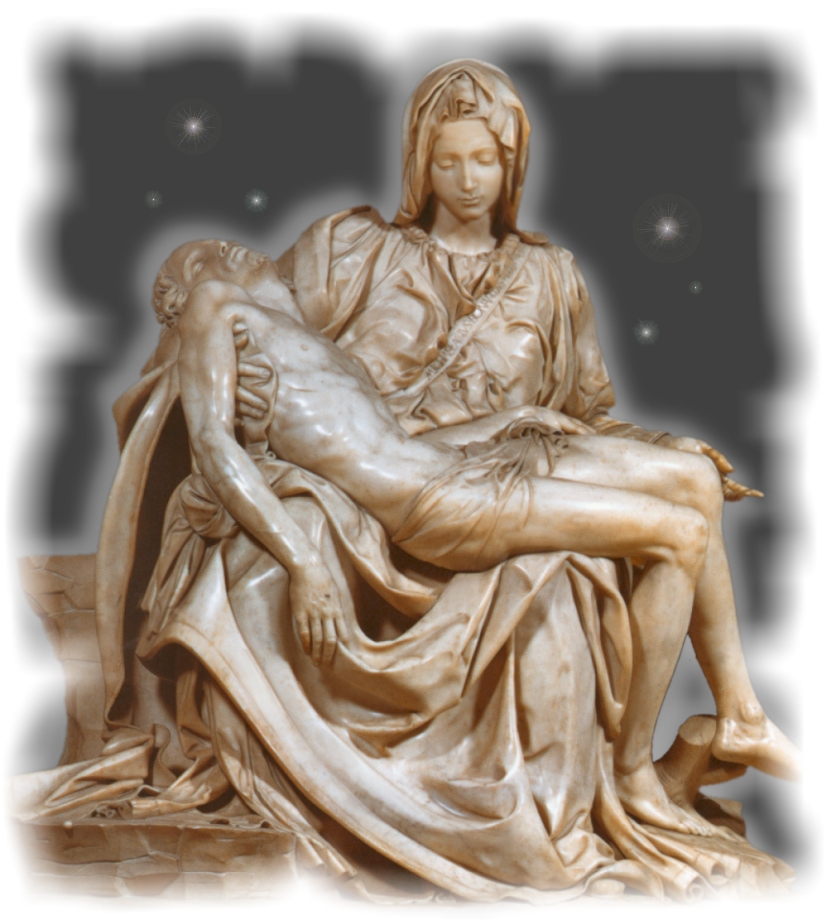

PRAYER TO THE SORROWFUL MOTHER

Most holy Mother of Sorrows, by that soul-piercing martyrdom thou didst undergo at the foot of the Cross during the three hours' agony of Jesus, deign to assist me also, who am the child of thy Sorrows, in my agony, so that by thine intercession I may be found worthy to pass from my deathbed to thy blessed society in Paradise.

V. From a sudden and unprovided death,
R. Deliver me, O Lord.
V. From the snares of the devil,
R. Deliver me, O Lord.
V. From everlasting death,
R. Deliver me, O Lord.

Let us pray.
O God, Who for the salvation of mankind hast made for us in the most bitter death of Thy Son both an example and a refuge; grant, we beseech Thee, that we may be found worthy to obtain the fruit of His great love in our final peril at the hour of death, and to be made partakers of our Redeemer's glory.  Through the same Christ our Lord. Amen.

Friday, April 15, 2011

PASSIO DOMINI: Accompanying Jesus in His Passion

Every week accompany Jesus in the Passio Domini (Passion of the Lord).


Some prayer suggestions you may choose according to your time and possibilities:


THURSDAY EVENING (e.g. 9 p.m. to 12 m.n.)


Follow His invitation in the Garden of Olives, to pray and keep watch with Him:


+ Adoration before the Blessed Sacrament (Holy Hour)
+ Meditation on the Holy Scripture , passages referring to the agony of Jesus
+ Holy Rosary
+ Prayer for Priests (I use the booklet Chalice of Strength given to me by Opus Angelorum)

+ Divine Mercy Chaplet
+ other appropriate prayers (e.g. Litany to the Precious Blood)
+ Prayers of Adoration and Reparation

FRIDAY AFTERNOON (in the time between 12 n.n. to 3 p.m.)

Accompany Jesus in His Passion, hanging on the Cross.

+ Holy Hour before the Blessed Sacrament
+ Meditation on the Passion and Death of Our Lord
+ Stations of the Cross
+ Holy Rosary (Sorrowful Mysteries)
+ Chaplet of the Divine Mercy
+ Litany of the Sacred Heart
+ other prayers or devotional exercises in honor of Our Lord's Passion

If your time schedule doesn't allow you to pray much during this time, because of school, house or work duties, accompany Jesus in your mind with some short prayers - important is your good will and love to be with Jesus, console Him and save souls with Him.

From The Confraternity of the Holy Guardian Angels (Opus Angelorum) Formation Booklet.

My Soul is sorrowful even unto death. stay here and watch (St. Mark XIV-34).

The Redemption accomplished through Jesus’ suffering, death and resurrection lies at the center of our Catholic faith. This mystery is commemorated every Thursday and Friday in the Work of the Holy Angels in the celebration of the Passio Domini (“Passion of Our Lord”), where we watch and compassionate our Lord in His redeeming suffering.

An angel was sent to Jesus in His agony to strengthen Him as He bore the weight of the world’s sins, while the three Apostles slept. Jesus asked them sadly, “Could you not watch one hour with Me?” Karol Wojtyla (Pope John Paul II), commenting on the carelessness of the three Apostles, said that these words of Jesus are…a reproach of concern to every disciple of Christ. In one way the Church still hears these same words: the reproach addressed to the three Apostles is accepted by the Church as if it were addressed to herself, and she tries to fill the gap left by that lost hour when Jesus remained completely alone in Gethsemane. …And now the Church still seeks to recover that hour in Gethsemane—the hour lost by Peter, James and John—so as to compensate for the Master’s lack of companionship which increased His soul’s suffering. (Sign of Contradiction, p. 151).

Jesus was strengthened not only by the angel, but also by all those generous souls foreseen by Him who, moved by His sorrowful complaint, have kept and continue to keep Him company in the Garden of Olives, watching and sharing His bitterness and mortal anguish. Pope Pius XI wrote in his encyclical letter, Miserentissimus Redemptor:
If, because of our sins also which were as yet in the future, but were foreseen, the soul of Christ became sorrowful unto death, it cannot be doubted that then, too, already He derived somewhat of a solace from our reparation, which was likewise foreseen, when “there appeared to Him an angel from heaven” (Lk. 22:43), in order that His Heart, oppressed with weariness and anguish, might find consolation. And so even now, in a wondrous yet true manner, we can and ought to console that Most Sacred Heart which is continually wounded by the sins of thankless men, since - as we also read in the sacred liturgy - Christ Himself, by the mouth of the Psalmist complains that He is forsaken by His friends: “My Heart hath expected reproach and misery, and I looked for one that would grieve together with me, but there was none: and for one that would comfort me, and I found none” (Psalm 118:21). (Miserentissimus Redemptor, 13)

St. Padre Pio, meditating on our Lord’s agony, also prayed:

O Jesus, how many generous souls wounded by this complaint have kept You company in the Garden, sharing Your bitterness and Your mortal anguish.... How many hearts in the course of the centuries have responded generously to Your invitation ... May this multitude of souls, then, in this supreme hour be a comfort to You, who, better than the disciples, share with You the distress of Your Heart, and cooperate with You for their own salvation and that of others. And grant that I also may be of their number, that I also may offer You some relief. (The Agony of Jesus, p. 22)

Encouraged by these words of both Popes and Saints, let us also lovingly share in Our Lord’s Passion through prayer, compassion and sacrifice, thus offering Him some relief and cooperating with Him towards our own salvation and the salvation of others.

This devotion is especially timely given the current situation in the Church, our country and the world. There is a great need to support our priests and bishops, so that they have the courage and strength to speak out and bear witness to basic Christian morals in our degenerating culture. We wish to give them spiritual support so that they may bear the burden of leading both the Church and the world in the ways of God, building up the culture of life as good shepherds after the Heart of Christ. 

We therefore would like to invite you to this communal celebration of the Passio Domini every Thursday. The hours of the Passion are times of special grace and intercessory power. If you cannot make it every week, you might strive for once a month or every first Thursday of the month. The Holy Mass and adoration of the Blessed Sacrament are the most efficacious means we have of obtaining graces both for ourselves and for others. 

We want to share this essential dimension of Opus Angelorum spirituality with all who wish to dedicate themselves to consoling the Heart of Christ in a special way, and to making reparation for our own sins and the sins of others. The Passion of Christ is at the center of every spirituality. Though this devotion demands sacrifice, it is one of the most important things we can do for our Church and country in these times. Jesus needs generous souls, who by God’s grace can accomplish great things through the little way of prayer and sacrifice.

Please come and join us as often as possible and spread the word! May God bless you and may His holy angels lead you to the Heart of Christ and His holy Mother.

Fr. Wolfgang Seitz, ORC

Thursday, March 17, 2011

LENTEN DEVOTIONS: The Via Crucis

131. Of all the pious exercises connected with the veneration of the Cross, none is more popular among the faithful than the Via Crucis. Through this pious exercise, the faithful movingly follow the final earthly journey of Christ: from the Mount of Olives, where the Lord, "in a small estate called Gethsemane" (Mk 14, 32), was taken by anguish (cf. Lk 22, 44), to Calvary where he was crucified between two thieves (cf. Lk 23, 33), to the garden where he was placed in freshly hewn tomb (John 19, 40-42).

The love of the Christian faithful for this devotion is amply attested by the numerous Via Crucis erected in so many churches, shrines, cloisters, in the countryside, and on mountain pathways where the various stations are very evocative.

132. The Via Crucis is a synthesis of various devotions that have arisen since the high middle ages: the pilgrimage to the Holy Land during which the faithful devoutly visit the places associated with the Lord's Passion; devotion to the three falls of Christ under the weight of the Cross; devotion to "the dolorous journey of Christ" which consisted in processing from one church to another in memory of Christ's Passion; devotion to the stations of Christ, those places where Christ stopped on his journey to Calvary because obliged to do so by his executioners or exhausted by fatigue, or because moved by compassion to dialogue with those who were present at his Passion.

In its present form, the Via Crucis, widely promoted by St. Leonardo da Porto Maurizio (+1751), was approved by the Apostolic See and indulgenced(137), consists of fourteen stations since the middle of seventeenth century.

133. The Via Crucis is a journey made in the Holy Spirit, that divine fire which burned in the heart of Jesus (cf. Lk 12, 49-50) and brought him to Calvary. This is a journey well esteemed by the Church since it has retained a living memory of the words and gestures of the final earthly days of her Spouse and Lord.

In the Via Crucis, various strands of Christian piety coalesce: the idea of life being a journey or pilgrimage; as a passage from earthly exile to our true home in Heaven; the deep desire to be conformed to the Passion of Christ; the demands of following Christ, which imply that his disciples must follow behind the Master, daily carrying their own crosses (cf Lk 9, 23).

The Via Crucis is a particularly apt pious exercise for Lent.

134. The following may prove useful suggestions for a fruitful celebration of the Via Crucis:

    * the traditional form of the Via Crucis, with its fourteen stations, is to be retained as the typical form of this pious exercise; from time to time, however, as the occasion warrants, one or other of the traditional stations might possibly be substituted with a reflection on some other aspects of the Gospel account of the journey to Calvary which are traditionally included in the Stations of the Cross;

    * alternative forms of the Via Crucis have been approved by Apostolic See(138) or publicly used by the Roman Pontiff(139): these can be regarded as genuine forms of the devotion and may be used as occasion might warrant;

    * the Via Crucis is a pious devotion connected with the Passion of Christ; it should conclude, however, in such fashion as to leave the faithful with a sense of expectation of the resurrection in faith and hope; following the example of the Via Crucis in Jerusalem which ends with a station at the Anastasis, the celebration could end with a commemoration of the Lord's resurrection.

135. Innumerable texts exist for the celebration of the Via Crucis. Many of them were compiled by pastors who were sincerely interested in this pious exercise and convinced of its spiritual effectiveness. Texts have also been provided by lay authors who were known for their exemplary piety, holiness of life, doctrine and literary qualities.

Bearing in mind whatever instructions might have been established by the bishops in the matter, the choice of texts for the Via Crucis should take a count of the condition of those participating in its celebration and the wise pastoral principle of integrating renewal and continuity. It is always preferable to choose texts resonant with the biblical narrative and written in a clear simple style.

The Via Crucis in which hymns, silence, procession and reflective pauses are wisely integrated in a balanced manner, contribute significantly to obtaining the spiritual fruits of the pious exercise.

Wednesday, March 16, 2011

LENTEN DEVOTIONS: The Reading of the Passion

130. The Church exhorts the faithful to frequent personal and community reading of the Word of God. Undoubtedly, the account of the Lord's Passion is among the most important pastoral passages in the New Testament. Hence, for the Christian in his last agony, the Ordo untionis informorum eorumque pastoralis curae suggests the reading of the Lord's Passion either in its entirety, or at least some pericopes from it.

During Lent, especially on Wednesdays and Fridays, love for our Crucified Saviour should move the Christian community to read the account of the Lord's Passion. Such reading, which is doctrinally significant, attracts the attention of the faithful because of its content and because of its narrative form, and inspires true devotion: repentance for sins, since the faithful see that Christ died for the sins of the entire human race, including their own; compassion and solidarity for the Innocent who was unjustly condemned; gratitude for the infinite love of Jesus for all the brethren, which was shown by Jesus, the first born Son, in his Passion; commitment to imitating his example of meekness, patience, mercy, forgiveness of offenses, abandonment to the Father, which Jesus did willingly and efficaciously in his Passion.

Outside of the liturgical celebration of the Passion, the Gospel narrative can be "dramatized", giving the various parts of the narrative to different persons; or by interspersing it with hymns or moments of silent reflection.

Tuesday, March 15, 2011

LENTEN DEVOTIONS: The Veneration of the Crucified Christ

127. The journey of Lent ends with the Easter Triduum, initiated by the celebration of the Coena Domini Mass. During the Triduum, Good Friday which is dedicated to the celebration of the Lord's Passion, is eminently suited for the "Adoration of the Holy Cross".

Popular piety tends to anticipate the cultic veneration of the Cross. Throughout Lent, every Friday is observed, since very ancient times, as a commemoration of the Lord's Passion and the faithful easily direct their devotions towards the mystery of the Cross.

They contemplate the crucified Saviour, they sense more easily the great suffering which Jesus, the Holy and Innocent One, suffered for the salvation of mankind. They understand his love and the effectiveness of his redemptive sacrifice.

128. The various and numerous devotions to the crucified Christ acquire a special significance in those churches dedicated to the mystery of the Cross or where authentic relics of the true cross are venerated. The "invention of the Cross" in the early fourth century, and the subsequent diffusion throughout the Church of particles of the true Cross, gave notable impulse to devotion to the Cross.

Devotions to the crucified Christ contain many elements usually found in popular piety: hymns and prayers, acts such as the unveiling and kissing of the Cross, processions and blessing with the Cross. These can lead to the development of pious exercises often containing many valuable formal and material elements.

Devotion to the Cross, however, sometimes requires a certain enlightenment. The faithful should be taught to place the Cross in its essential reference to the Resurrection of Christ: the Cross, the empty tomb, the Death and Resurrection of Christ are indispensable in the Gospel narrative of God's salvific plan. In the Christian faith, the Cross is an expression of the triumph of Christ over the powers of darkness. Hence, it is adorned with precious stones and is a sign of blessing when made upon one's self, or on others or on objects.

129. The Gospel texts of the Passion are especially detailed. Coupled with a tendency in popular piety to isolate specific moments of the narrative, this has induced the faithful to turn their attention to specific aspects of the Passion of Christ, making of them specific devotions: devotion to the "Ecce Homo", Christ despised, "crowned with thorns and clothed in a purple cloak" (John 19, 5), and shown to the multitude by Pilate; devotion to the five sacred wounds of Christ, especially to the side of Christ from which flowed blood and water for the salvation of mankind (John 19, 34); devotion to the instruments of the Passion, the pillar at which Christ was scourged, the steps of the Praetorium, the crown of thorns, the nails, the lance that pierced Him; devotion to the Holy Shroud.

Such expressions of piety, often promoted by persons of great sanctity, are legitimate. However, in order to avoid excessive fragmentation in contemplation of the mystery of the Cross, it is always useful to emphasize the whole event of the Passion, as is the case in biblical and patristic tradition.

From the Directory on Popular Piety and the Liturgy