Showing posts with label Pope Benedict XVI. Show all posts

Monday, January 9, 2012

FEAST OF THE LORD'S BAPTISM


The words that the Evangelist Mark recounts at the beginning of his Gospel: "You are my beloved Son; with you I am well pleased" (1: 11), introduce us into the heart of today's Feast of the Baptism of the Lord with which the Christmas Season ends. The cycle of the Christmas Solemnities leads us to meditate on the birth of Jesus, announced by the angels who were surrounded with the luminous splendour of God; the Christmas Season speaks to us of the star that guided the Magi of the East to the House in Bethlehem, and invites us to look to Heaven, which opens above the Jordan as God's voice resounds. These are all signs through which the Lord never tires of repeating: "Yes, I am here. I know you. I love you. There is a path that leads from me to you. And there is a path that rises from you to me". The Creator assumed the dimensions of a child in Jesus, of a human being like us, to make himself visible and tangible. At the same time, by making himself small, God caused the light of his greatness to shine. For precisely by lowering himself to the point of defenseless vulnerability of love, he shows what his true greatness is indeed, what it means to be God.

Christmas, and more generally the liturgical year, is exactly that drawing near to these divine signs, to recognize them as impressed into daily events, so that our hearts may be open to God's love. And if Christmas and Epiphany serve primarily to render us capable of seeing, of opening our eyes and hearts to the mystery of a God who comes to be with us, then we can say that the Feast of the Baptism of Jesus introduces us into the daily regularity of a personal relationship with him. Indeed, by immersion in the waters of the Jordan, Jesus united himself with us. Baptism is, so to speak, the bridge he built between himself and us, the road on which he makes himself accessible to us. It is the divine rainbow over our lives, the promise of God's great "yes", the door of hope and, at the same time, the sign that that indicates to us the path to take actively and joyfully in order to encounter him and feel loved by him.

Dear friends, I am truly glad that this year too, on this Feast day, I have been granted the opportunity to baptize these children. God's "favour" rests on them today. Ever since the Only-Begotten Son of the Father had himself baptized, the heavens are truly open and continue to open, and we may entrust every new life that begins into the hands of the One who is more powerful than the dark powers of evil. This effectively includes Baptism: we restore to God what came from him. The child is not the property of the parents but is entrusted to their responsibility by the Creator, freely and in a way that is ever new, in order that they may help him or her to be a free child of God. Only if the parents develop this awareness will they succeed in finding the proper balance between the claim that their children are at their disposal, as though they were a private possession, shaping them on the basis of their own ideas and desires, and the libertarian approach that is expressed in letting them grow in full autonomy, satisfying their every desire and aspiration, deeming this the right way to cultivate their personality. If, with this sacrament, the newly-baptized becomes an adoptive child of God, the object of God's infinite love that safeguards him and protects him from the dark forces of the evil one, it is necessary to teach the child to recognize God as Father and to be able to relate to him with a filial attitude. And therefore, when in accordance with the Christian tradition as we are doing today children are baptized and introduced into the light of God and of his teachings, no violence is done to them. Rather, they are given the riches of divine life in which is rooted the true freedom that belongs to the children of God a freedom that must be educated and modeled as the years pass to render it capable of responsible personal decisions.

Dear parents, dear godfathers and godmothers, I greet you all with affection and join in your joy for these little ones who today are reborn into eternal life. May you be aware of the gift received and never cease to thank the Lord who, with today's sacrament, introduces your children into a new family, larger and more stable, more open and more numerous than your own; I am referring to the family of believers, to the Church, to a family that has God as Father and in which all recognize one another as brothers and sisters in Jesus Christ. Today, therefore, you are entrusting your children to God's goodness, which is a force of light and love and they, even amid life's difficulties, will never feel abandoned if they stay united with him. Therefore, be concerned with educating them in the faith, teaching them to pray and grow as Jesus did and with his help, "in wisdom and in stature, and in favour with God and man" (Lk 2: 52).

Returning now to the Gospel passage, let us seek to better understand what is happening today. St Mark recounts that it was just when John the Baptist was preaching on the banks of the River Jordan, proclaiming the urgent need for conversion in view of the now imminent coming of the Messiah, that Jesus, who was among the crowds, presented himself to be baptized. John's Baptism is indisputably a Baptism of penance, very different from the sacrament that Jesus was to institute. At that moment, however, the Redeemer's mission is already glimpsed because, when he comes out of the water, a voice comes from Heaven and the Holy Spirit descends upon him (cf. Mk 1: 10); the heavenly Father proclaims him as his beloved Son and publicly attests to his universal saving mission, which will be fully accomplished with his death on the Cross and his Resurrection. Only then, with the Paschal Sacrifice, would the forgiveness of sins be rendered universal and total. With Baptism we do not simply emerge from the waters of the Jordan to proclaim our commitment to conversion, but the redeeming Blood of Christ that purifies and saves us is poured out upon us. It is the Father's beloved Son, in whom he was pleased, who regains for us the dignity and joy of calling ourselves truly "children" of God.

In a little while we shall relive this mystery evoked by today's solemnity; the signs and symbols of the sacrament of Baptism will help us to understand what the Lord works in the hearts of these our little ones, making them "his" for ever, the chosen dwelling place of his Spirit and "living stones" for the construction of the spiritual temple which is the Church. May the Virgin Mary, Mother of Jesus, the beloved Son of God, watch over them and their families and always accompany them, so that they may fully carry out the plan of salvation that is brought into their lives through Baptism. And may we, dear brothers and sisters, accompany them with our prayers. Let us pray for the parents, godparents, and godmothers and for their relatives, so that they may help them grow in faith. Let us pray for all of us here present so that, by devoutly taking part in this celebration, we may renew the promises of our Baptism and give thanks to the Lord for his constant assistance. Amen! 

POPE BENEDICT XVI
January 11, 2009

Sunday, January 8, 2012

EPIPHANY


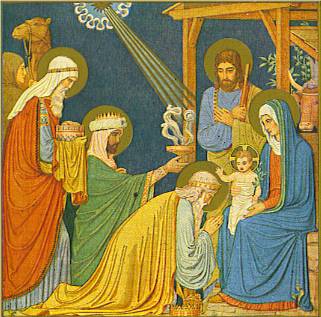
The Epiphany is a feast of light. “Arise, shine; for your light has come, and the glory of the Lord has risen upon you” (Is 60:1). With these words of the prophet Isaiah, the Church describes the content of the feast. He who is the true light, and by whom we too are made to be light, has indeed come into the world. He gives us the power to become children of God (cf. Jn 1:9,12). The journey of the wise men from the East is, for the liturgy, just the beginning of a great procession that continues throughout history. With the Magi, humanity’s pilgrimage to Jesus Christ begins – to the God who was born in a stable, who died on the Cross and who, having risen from the dead, remains with us always, until the consummation of the world (cf. Mt 28:20). The Church reads this account from Matthew’s Gospel alongside the vision of the prophet Isaiah that we heard in the first reading: the journey of these men is just the beginning. Before them came the shepherds – simple souls, who dwelt closer to the God who became a child, and could more easily “go over” to him (Lk 2:15) and recognize him as Lord. But now the wise of this world are also coming. Great and small, kings and slaves, men of all cultures and all peoples are coming. The men from the East are the first, followed by many more throughout the centuries. After the great vision of Isaiah, the reading from the Letter to the Ephesians expresses the same idea in sober and simple terms: the Gentiles share the same heritage (cf. Eph 3:6). Psalm 2 puts it like this: “I shall bequeath you the nations, put the ends of the earth in your possession” (v. 8).

The wise men from the East lead the way. They open up the path of the Gentiles to Christ. During this holy Mass, I will ordain two priests to the episcopate, I will consecrate them as shepherds of God’s people. According to the words of Jesus, part of a shepherd’s task is to go ahead of the flock (cf. Jn 10:4). So, allowing for all the differences in vocation and mission, we may well look to these figures, the first Gentiles to find the pathway to Christ, for indications concerning the task of bishops. What kind of people were they? The experts tell us that they belonged to the great astronomical tradition that had developed in Mesopotamia over the centuries and continued to flourish. But this information of itself is not enough. No doubt there were many astronomers in ancient Babylon, but only these few set off to follow the star that they recognized as the star of the promise, pointing them along the path towards the true King and Saviour. They were, as we might say, men of science, but not simply in the sense that they were searching for a wide range of knowledge: they wanted something more. They wanted to understand what being human is all about. They had doubtless heard of the prophecy of the Gentile prophet Balaam: “A star shall come forth out of Jacob and a sceptre shall rise out of Israel” (Num 24:17). They explored this promise. They were men with restless hearts, not satisfied with the superficial and the ordinary. They were men in search of the promise, in search of God. And they were watchful men, capable of reading God’s signs, his soft and penetrating language. But they were also courageous, yet humble: we can imagine them having to endure a certain amount of mockery for setting off to find the King of the Jews, at the cost of so much effort. For them it mattered little what this or that person, what even influential and clever people thought and said about them. For them it was a question of truth itself, not human opinion. Hence they took upon themselves the sacrifices and the effort of a long and uncertain journey. Their humble courage was what enabled them to bend down before the child of poor people and to recognize in him the promised King, the one they had set out, on both their outward and their inward journey, to seek and to know.

Dear friends, how can we fail to recognize in all this certain essential elements of episcopal ministry? The bishop too must be a man of restless heart, not satisfied with the ordinary things of this world, but inwardly driven by his heart’s unrest to draw ever closer to God, to seek his face, to recognize him more and more, to be able to love him more and more. The bishop too must be a man of watchful heart, who recognizes the gentle language of God and understands how to distinguish truth from mere appearance. The bishop too must be filled with the courage of humility, not asking what prevailing opinion says about him, but following the criterion of God’s truth and taking his stand accordingly – “opportune – importune”. He must be able to go ahead and mark out the path. He must go ahead, in the footsteps of him who went ahead of us all because he is the true shepherd, the true star of the promise: Jesus Christ. And he must have the humility to bend down before the God who made himself so tangible and so simple that he contradicts our foolish pride in its reluctance to see God so close and so small. He must devote his life to adoration of the incarnate Son of God, which constantly points him towards the path.

The liturgy of episcopal ordination interprets the essential features of this ministry in eight questions addressed to the candidates, each beginning with the word “Vultis? – Do you want?” These questions direct the will and mark out the path to be followed. Here I shall briefly cite just a few of the most important words of this presentation, where we find explicit mention of the elements we have just considered in connection with the wise men of today’s feast. The bishops’ task is praedicare Evangelium Christi, it is custodire et dirigere, it is pauperibus se misericordes praebere, it is indesinenter orare. Preaching the Gospel of Jesus Christ, going ahead and leading, guarding the sacred heritage of our faith, showing mercy and charity to the needy and the poor, thus mirroring God’s merciful love for us, and finally, praying without ceasing: these are the fundamental features of the episcopal ministry. Praying without ceasing means: never losing contact with God, letting ourselves be constantly touched by him in the depths of our hearts and, in this way, being penetrated by his light. Only someone who actually knows God can lead others to God. Only someone who leads people to God leads them along the path of life.

The restless heart of which we spoke earlier, echoing Saint Augustine, is the heart that is ultimately satisfied with nothing less than God, and in this way becomes a loving heart. Our heart is restless for God and remains so, even if every effort is made today, by means of most effective anaesthetizing methods, to deliver people from this unrest. But not only are we restless for God: God’s heart is restless for us. God is waiting for us. He is looking for us. He knows no rest either, until he finds us. God’s heart is restless, and that is why he set out on the path towards us – to Bethlehem, to Calvary, from Jerusalem to Galilee and on to the very ends of the earth. God is restless for us, he looks out for people willing to “catch” his unrest, his passion for us, people who carry within them the searching of their own hearts and at the same time open themselves to be touched by God’s search for us. Dear friends, this was the task of the Apostles: to receive God’s unrest for man and then to bring God himself to man. And this is your task as successors of the Apostles: let yourselves be touched by God’s unrest, so that God’s longing for man may be fulfilled.

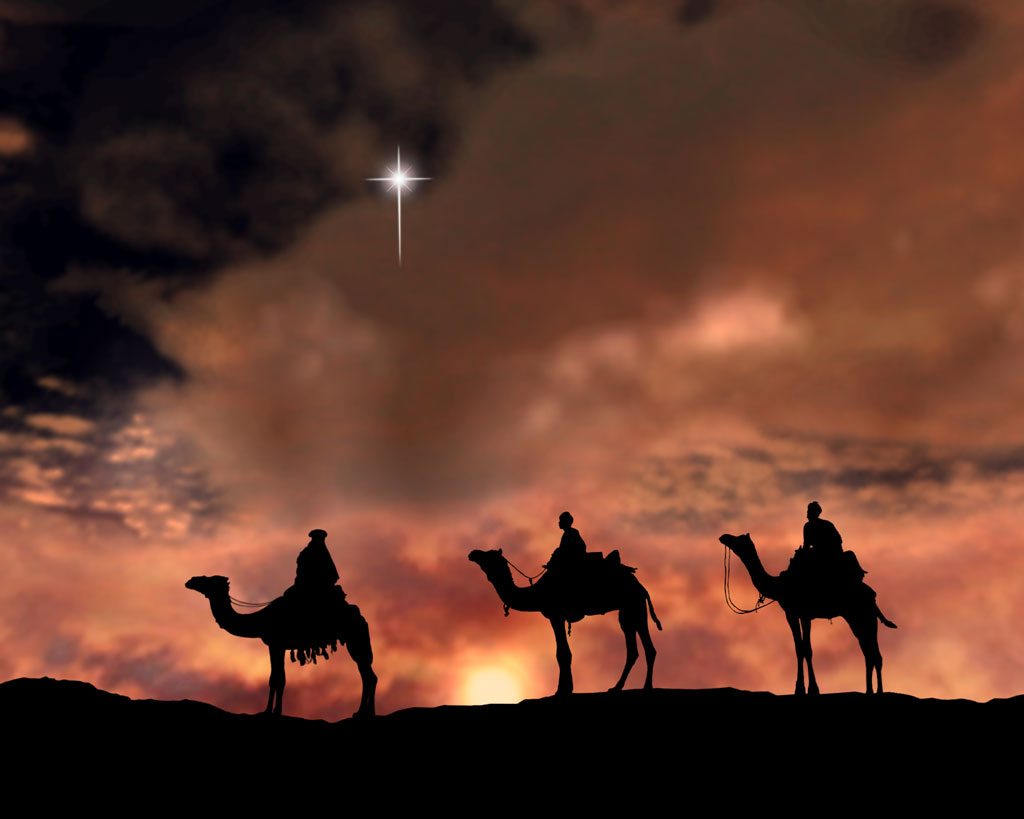
The wise men followed the star. Through the language of creation, they discovered the God of history. To be sure – the language of creation alone is not enough. Only God’s word, which we encounter in sacred Scripture, was able to mark out their path definitively. Creation and Scripture, reason and faith, must come together, so as to lead us forward to the living God. There has been much discussion over what kind of star it was that the wise men were following. Some suggest a planetary constellation, or a supernova, that is to say one of those stars that is initially quite weak, in which an inner explosion releases a brilliant light for a certain time, or a comet, etc. This debate we may leave to the experts. The great star, the true supernova that leads us on, is Christ himself. He is as it were the explosion of God’s love, which causes the great white light of his heart to shine upon the world. And we may add: the wise men from the East, who feature in today’s Gospel, like all the saints, have themselves gradually become constellations of God that mark out the path. In all these people, being touched by God’s word has, as it were, released an explosion of light, through which God’s radiance shines upon our world and shows us the path. The saints are stars of God, by whom we let ourselves be led to him for whom our whole being longs. Dear friends: you followed the star Jesus Christ when you said “yes” to the priesthood and to the episcopacy. And no doubt smaller stars have enlightened and helped you not to lose your way. In the litany of saints we call upon all these stars of God, that they may continue to shine upon you and show you the path. As you are ordained bishops, you too are called to be stars of God for men, leading them along the path towards the true light, towards Christ. So let us pray to all the saints at this hour, asking them that you may always live up to this mission you have received, to show God’s light to mankind.

© Copyright 2012 - Libreria Editrice Vaticana

Saturday, January 7, 2012

Pope Benedict XVI's End of Year Homily (Vespers)


Another year is drawing to a close, as we await the start of a new one: with some trepidation, with our perennial desires and expectations. Reflecting on our life experience, we are continually astonished by how ultimately short and ephemeral life is. So we often find ourselves asking: what meaning can we give to our days? What meaning, in particular, can we give to the days of toil and grief? This is a question that permeates history, indeed it runs through the heart of every generation and every individual. But there is an answer: it is written on the face of a Child who was born in Bethlehem two thousand years ago, and is today the Living One, risen for ever from the dead. From within the fabric of humanity, rent asunder by so much injustice, wickedness and violence, there bursts forth in an unforeseen way the joyful and liberating novelty of Christ our Saviour, who leads us to contemplate the goodness and tenderness of God through the mystery of his Incarnation and Birth. The everlasting God has entered our history and he remains present in a unique way in the person of Jesus, his incarnate Son, our Saviour, who came down to earth to renew humanity radically and to free us from sin and death, to raise us to the dignity of God’s children. Christmas not only recalls the historical fulfilment of this truth that concerns us directly, but in a mysterious and real way, gives it to us afresh.

How evocative it is, at this close of a year, to listen again to the joyful message addressed by Saint Paul to the Christians of Galatia: “when the time had fully come, God sent forth his Son, born of woman, born under the law, to redeem those who were under the law, so that we might receive adoption as sons” (Gal 4:4-5). These words penetrate the heart of the history of us all and illumine it, or rather, they save it, because since the Day of the Lord’s Nativity, the fullness of time has reached us. So there is no more room for anxiety in the face of time that passes, never to return; now there is room for unlimited trust in God, by whom we know we are loved, for whom we live and to whom our life is directed as we await his definitive return. Since the Saviour came down from heaven, man has ceased to be the slave of time that passes to no avail, marked by toil, sadness and pain. Man is son of a God who has entered time so as to redeem it from meaninglessness and negativity, a God who has redeemed all humanity, giving it everlasting love as a new perspective of life.

The Church lives and professes this truth and intends to proclaim it today with fresh spiritual vigour. In tonight’s celebration we have special reasons to praise God for his mystery of salvation, active in the world through the ministry of the Church… 

In the Diocese of Rome, as elsewhere, the most urgent pastoral challenge facing us is the quaestio fidei. Christ’s disciples are called to reawaken in themselves and in others the longing for God and the joy of living him and bearing witness to him, on the basis of what is always a deeply personal question: why do I believe? We must give primacy to truth, seeing the combination of faith and reason as two wings with which the human spirit can rise to the contemplation of the Truth (cf. Fides et Ratio, Prologue); we must ensure that the dialogue between Christianity and modern culture bears fruit; we must see to it that the beauty and contemporary relevance of the faith is rediscovered, not as an isolated event, affecting some particular moment in our lives, but as a constant orientation, affecting even the simplest choices, establishing a profound unity within the person, so that he becomes just, hard-working, generous and good. What is needed is to give new life to a faith that can serve as a basis for a new humanism, one that is able to generate culture and social commitment.

Within this framework, at the Diocesan Conference held last June, the Diocese of Rome launched a programme which sets out to explore more deeply the meaning of Christian initiation and the joy of bringing new Christians into the faith. To proclaim faith in the Word made flesh is, after all, at the heart of the Church’s mission, and the entire ecclesial community needs to rediscover this indispensable task with renewed missionary zeal. Young generations have an especially keen sense of the present disorientation, magnified by the crisis in economic affairs which is also a crisis of values, and so they in particular need to recognize in Jesus Christ “the key, the centre and the purpose of the whole of human history” (Gaudium et Spes, 10).

Parents are the first educators in faith of their children, starting from a most tender age, and families must therefore be supported in their educational mission by appropriate initiatives. At the same time it is desirable that the baptismal journey, the first stage along the formative path of Christian initiation, in addition to fostering conscious and worthy preparation for the celebration of the Sacrament, should devote adequate attention to the years following Baptism, with appropriate programmes that take account of the life conditions that families must address. I therefore encourage parish communities and other ecclesial groupings to engage in continuing reflection on ways to promote a better understanding and reception of the sacraments, by which man comes to share in the very life of God…

Dear friends, ever since God sent his only-begotten Son, so that we might obtain adoptive sonship (cf. Gal 4:5), we can have no greater task than to be totally at the service of God’s plan…

Te Deum laudamus! We praise you, O God! The Church suggests that we should not end the year without expressing our thanks to the Lord for all his benefits. It is in God that our last hour must come to a close, the last hour of time and history. To overlook this goal of our lives would be to fall into the void, to live without meaning. Hence the Church places on our lips the ancient hymn Te Deum. It is a hymn filled with the wisdom of many Christian generations, who feel the need to address on high their heart’s desires, knowing that all of us are in the Lord’s merciful hands…

© Copyright 2011 - Libreria Editrice Vaticana

Friday, January 6, 2012

Epiphany: THE DEEP DESIRE OF THE MAGI


Why did the Magi set off from afar to go to Bethlehem? The answer has to do with the mystery of the "star" which they saw "in the East" and which they recognized as the star of the "King of the Jews", that is to say, the sign of the birth of the Messiah (cf. Mt 2: 2). So their journey was inspired by a powerful hope, strengthened and guided by the star, which led them towards the King of the Jews, towards the kingship of God himself. This is the meaning behind our journey:  to serve the kingship of God in the world.

The Magi set out because of a deep desire which prompted them to leave everything and begin a journey. It was as though they had always been waiting for that star. It was as if the journey had always been a part of their destiny, and was finally about to begin.

Dear friends, this is the mystery of God's call, the mystery of vocation. It is part of the life of every Christian, but it is particularly evident in those whom Christ asks to leave everything in order to follow him more closely…

The better you know Jesus the more his mystery attracts you. The more you discover him, the more you are moved to seek him. This is a movement of the Spirit which lasts throughout life, and which makes the seminary a time of immense promise, a true "springtime".

When the Magi came to Bethlehem, "going into the house they saw the child with Mary his mother, and they fell down and worshiped him" (Mt 2: 11). Here at last was the long-awaited moment:  their encounter with Jesus.

"Going into the house":  this house in some sense represents the Church. In order to find the Saviour, one has to enter the house, which is the Church… the home of Christ, where "Mary his mother" dwells.

It is Mary who shows him Jesus her Son; she introduces him and in a sense enables him to see and touch Jesus, and to take him into his arms. Mary teaches the seminarian to contemplate Jesus with the eyes of the heart and to make Jesus his very life.

Each moment of… life can be an opportunity for loving experience of the presence of Our Lady, who introduces everyone to an encounter with Christ in the silence of meditation, prayer and fraternity. Mary helps us to meet the Lord above all in the celebration of the Eucharist, when, in the Word and in the consecrated Bread, he becomes our daily spiritual nourishment.

"They fell down and worshiped him... and offered him gifts:  gold, frankincense and myrrh" (Mt 2: 11-12). Here is the culmination of the whole journey:  encounter becomes adoration; it blossoms into an act of faith and love which acknowledges in Jesus, born of Mary, the Son of God made man.

How can we fail to see prefigured in this gesture of the Magi the faith of Simon Peter and of the other Apostles, the faith of Paul and of all the saints, particularly of the many saintly seminarians and priests who have graced the 2,000 years of the Church's history?

The secret of holiness is friendship with Christ and faithful obedience to his will. St Ambrose said:  "Christ is everything for us"; and St Benedict warned against putting anything before the love of Christ.

May Christ be everything for you…[B]e the first to offer him what is most precious to you, as Pope John Paul II suggested in his Message for this World Youth Day:  the gold of your freedom, the incense of your ardent prayer, the myrrh of your most profound affection (cf. n. 4).

..The Magi "departed for their own country" and most certainly bore witness to their encounter with the King of the Jews.

On their homeward journey, the Magi surely had to deal with dangers, weariness, disorientation, doubts. The star was no longer there to guide them! The light was now within them. Their task was to guard and nourish it in the constant memory of Christ, of his Holy Face, of his ineffable Love.

…Remember always the words of Jesus: "Abide in my love" (Jn 15: 9). If you abide close to Christ, with Christ and in Christ, you will bear much fruit, just as he promised. You have not chosen him - we have just heard this in the witnesses given -, he has chosen you (cf. Jn 15: 16). 

POPE BENEDICT XVI
Address to Seminarians
19 August 2005 - World Youth Day

Pope Benedict XVI's Christmas Homily


The reading from Saint Paul’s Letter to Titus that we have just heard begins solemnly with the word “apparuit”, which then comes back again in the reading at the Dawn Mass: apparuit – “there has appeared”. This is a programmatic word, by which the Church seeks to express synthetically the essence of Christmas. Formerly, people had spoken of God and formed human images of him in all sorts of different ways. God himself had spoken in many and various ways to mankind (cf. Heb 1:1 – Mass during the Day). But now something new has happened: he has appeared. He has revealed himself. He has emerged from the inaccessible light in which he dwells. He himself has come into our midst. This was the great joy of Christmas for the early Church: God has appeared. No longer is he merely an idea, no longer do we have to form a picture of him on the basis of mere words. He has “appeared”. But now we ask: how has he appeared? Who is he in reality? The reading at the Dawn Mass goes on to say: “the kindness and love of God our Saviour for mankind were revealed” (Tit 3:4). For the people of pre-Christian times, whose response to the terrors and contradictions of the world was to fear that God himself might not be good either, that he too might well be cruel and arbitrary, this was a real “epiphany”, the great light that has appeared to us: God is pure goodness. Today too, people who are no longer able to recognize God through faith are asking whether the ultimate power that underpins and sustains the world is truly good, or whether evil is just as powerful and primordial as the good and the beautiful which we encounter in radiant moments in our world. “The kindness and love of God our Saviour for mankind were revealed”: this is the new, consoling certainty that is granted to us at Christmas.

In all three Christmas Masses, the liturgy quotes a passage from the Prophet Isaiah, which describes the epiphany that took place at Christmas in greater detail: “A child is born for us, a son given to us and dominion is laid on his shoulders; and this is the name they give him: Wonder-Counsellor, Mighty-God, Eternal-Father, Prince-of-Peace. Wide is his dominion in a peace that has no end” (Is 9:5f.). Whether the prophet had a particular child in mind, born during his own period of history, we do not know. But it seems impossible. This is the only text in the Old Testament in which it is said of a child, of a human being: his name will be Mighty-God, Eternal-Father. We are presented with a vision that extends far beyond the historical moment into the mysterious, into the future. A child, in all its weakness, is Mighty God. A child, in all its neediness and dependence, is Eternal Father. And his peace “has no end”. The prophet had previously described the child as “a great light” and had said of the peace he would usher in that the rod of the oppressor, the footgear of battle, every cloak rolled in blood would be burned (Is 9:1, 3-4).

God has appeared – as a child. It is in this guise that he pits himself against all violence and brings a message that is peace. At this hour, when the world is continually threatened by violence in so many places and in so many different ways, when over and over again there are oppressors’ rods and bloodstained cloaks, we cry out to the Lord: O mighty God, you have appeared as a child and you have revealed yourself to us as the One who loves us, the One through whom love will triumph. And you have shown us that we must be peacemakers with you. We love your childish estate, your powerlessness, but we suffer from the continuing presence of violence in the world, and so we also ask you: manifest your power, O God. In this time of ours, in this world of ours, cause the oppressors’ rods, the cloaks rolled in blood and the footgear of battle to be burned, so that your peace may triumph in this world of ours.

Christmas is an epiphany – the appearing of God and of his great light in a child that is born for us. Born in a stable in Bethlehem, not in the palaces of kings. In 1223, when Saint Francis of Assisi celebrated Christmas in Greccio with an ox and an ass and a manger full of hay, a new dimension of the mystery of Christmas came to light. Saint Francis of Assisi called Christmas “the feast of feasts” – above all other feasts – and he celebrated it with “unutterable devotion” (2 Celano 199; Fonti Francescane, 787). He kissed images of the Christ-child with great devotion and he stammered tender words such as children say, so Thomas of Celano tells us (ibid.). For the early Church, the feast of feasts was Easter: in the Resurrection Christ had flung open the doors of death and in so doing had radically changed the world: he had made a place for man in God himself. Now, Francis neither changed nor intended to change this objective order of precedence among the feasts, the inner structure of the faith centred on the Paschal Mystery. And yet through him and the character of his faith, something new took place: Francis discovered Jesus’ humanity in an entirely new depth. This human existence of God became most visible to him at the moment when God’s Son, born of the Virgin Mary, was wrapped in swaddling clothes and laid in a manger. The Resurrection presupposes the Incarnation. For God’s Son to take the form of a child, a truly human child, made a profound impression on the heart of the Saint of Assisi, transforming faith into love. “The kindness and love of God our Saviour for mankind were revealed” – this phrase of Saint Paul now acquired an entirely new depth. In the child born in the stable at Bethlehem, we can as it were touch and caress God. And so the liturgical year acquired a second focus in a feast that is above all a feast of the heart.

This has nothing to do with sentimentality. It is right here, in this new experience of the reality of Jesus’ humanity that the great mystery of faith is revealed. Francis loved the child Jesus, because for him it was in this childish estate that God’s humility shone forth. God became poor. His Son was born in the poverty of the stable. In the child Jesus, God made himself dependent, in need of human love, he put himself in the position of asking for human love – our love. Today Christmas has become a commercial celebration, whose bright lights hide the mystery of God’s humility, which in turn calls us to humility and simplicity. Let us ask the Lord to help us see through the superficial glitter of this season, and to discover behind it the child in the stable in Bethlehem, so as to find true joy and true light.

Francis arranged for Mass to be celebrated on the manger that stood between the ox and the ass (cf. 1 Celano 85; Fonti 469). Later, an altar was built over this manger, so that where animals had once fed on hay, men could now receive the flesh of the spotless lamb Jesus Christ, for the salvation of soul and body, as Thomas of Celano tells us (cf. 1 Celano 87; Fonti 471). Francis himself, as a deacon, had sung the Christmas Gospel on the holy night in Greccio with resounding voice. Through the friars’ radiant Christmas singing, the whole celebration seemed to be a great outburst of joy (1 Celano 85.86; Fonti 469, 470). It was the encounter with God’s humility that caused this joy – his goodness creates the true feast.

Today, anyone wishing to enter the Church of Jesus’ Nativity in Bethlehem will find that the doorway five and a half metres high, through which emperors and caliphs used to enter the building, is now largely walled up. Only a low opening of one and a half metres has remained. The intention was probably to provide the church with better protection from attack, but above all to prevent people from entering God’s house on horseback. Anyone wishing to enter the place of Jesus’ birth has to bend down. It seems to me that a deeper truth is revealed here, which should touch our hearts on this holy night: if we want to find the God who appeared as a child, then we must dismount from the high horse of our “enlightened” reason. We must set aside our false certainties, our intellectual pride, which prevents us from recognizing God’s closeness. We must follow the interior path of Saint Francis – the path leading to that ultimate outward and inward simplicity which enables the heart to see. We must bend down, spiritually we must as it were go on foot, in order to pass through the portal of faith and encounter the God who is so different from our prejudices and opinions – the God who conceals himself in the humility of a newborn baby. In this spirit let us celebrate the liturgy of the holy night, let us strip away our fixation on what is material, on what can be measured and grasped. Let us allow ourselves to be made simple by the God who reveals himself to the simple of heart. And let us also pray especially at this hour for all who have to celebrate Christmas in poverty, in suffering, as migrants, that a ray of God’s kindness may shine upon them, that they – and we – may be touched by the kindness that God chose to bring into the world through the birth of his Son in a stable. Amen.

© Copyright 2011 - Libreria Editrice Vaticana

Sunday, June 26, 2011

CORPUS CHRISTI: "This is my Body.... This is my Blood".

"This is my Body.... This is my Blood".

Dear Brothers and Sisters,

These words that Jesus spoke at the Last Supper are repeated every time that the Eucharistic Sacrifice is renewed. We have just heard them in Mark's Gospel and they resonate with special power today on the Solemnity of Corpus Christi. They lead us in spirit to the Upper Room, they make us relive the spiritual atmosphere of that night when, celebrating Easter with his followers, the Lord mystically anticipated the sacrifice that was to be consummated the following day on the Cross. The Institution of the Eucharist thus appears to us as an anticipation and acceptance, on Jesus' part, of his death. St Ephrem the Syrian writes on this topic: during the Supper Jesus sacrificed himself; on the Cross he was sacrificed by others (cf. Hymn on the Crucifixion, 3, 1).

"This is my Blood". Here the reference to the sacrificial language of Israel is clear. Jesus presents himself as the true and definitive sacrifice, in which was fulfilled the expiation of sins which, in the Old Testament rites, was never fully completed. This is followed by two other very important remarks. First of all, Jesus Christ says that his Blood "is poured out for many" with a comprehensible reference to the songs of the Servant of God that are found in the Book of Isaiah (cf. ch. 53). With the addition "blood of the Covenant" Jesus also makes clear that through his death the prophesy of the new Covenant is fulfilled, based on the fidelity and infinite love of the Son made man. An alliance that, therefore, is stronger than all humanity's sins. The old Covenant had been sealed on Sinai with a sacrificial rite of animals, as we heard in the First Reading, and the Chosen People, set free from slavery in Egypt, had promised to obey all the commandments given to them by the Lord (cf. Ex 24: 3).

In truth, Israel showed immediately by making the golden calf that it was incapable of staying faithful to this promise and thus to the divine Covenant, which indeed it subsequently violated all too often, adapting to its heart of stone the Law that should have taught it the way of life. However, the Lord did not fail to keep his promise and, through the prophets, sought to recall the inner dimension of the Covenant and announced that he would write a new law upon the hearts of his faithful (cf. Jer 31: 33), transforming them with the gift of the Spirit (cf. Ez 36: 25-27). And it was during the Last Supper that he made this new Covenant with his disciples and humanity, confirming it not with animal sacrifices as had happened in the past, but indeed with his own Blood, which became the "Blood of the New Covenant". Thus he based it on his own obedience, stronger, as I said, than all our sins.

This is clearly highlighted in the Second Reading, taken from the Letter to the Hebrews, in which the sacred author declares that Jesus is the "mediator of a new covenant" (9: 15). He became so through his blood, or, more exactly, through the gift of himself, which gives full value to the outpouring of his blood. On the Cross, Jesus is at the same time victim and priest: a victim worthy of God because he was unblemished, and a High Priest who offers himself, by the power of the Holy Spirit, and intercedes for the whole of humanity. The Cross is therefore a mystery of love and of salvation which cleanses us as the Letter to the Hebrews states from "dead works", that is, from sins, and sanctifies us by engraving the New Covenant upon our hearts. The Eucharist, making present the sacrifice of the Cross, renders us capable of living communion with God faithfully.

Dear brothers and sisters whom I greet with affection, starting with the Cardinal Vicar and the other Cardinals and Bishops present like the Chosen People gathered on Sinai, this evening let us too reaffirm our fidelity to the Lord. A few days ago, in opening the annual Diocesan Convention [of Rome] I recalled the importance of remaining, as Church, attentive to the word of God in prayer and in exploring the Scriptures, especially through the practice of lectio divina, that is, through reading the Bible in meditation and veneration. I know that in this respect many initiatives which enrich our diocesan community have been promoted in parishes, seminaries and religious communities, in confraternities and in apostolic associations and movements. I address my fraternal greeting to the members of this multiplicity of Church bodies. Your numerous presence at this celebration, dear friends, highlights the fact that God moulds our community, characterized by a plurality of cultures and by different experiences. God moulds it as "his" People, as the one Body of Christ, thanks to our heartfelt participation in the twofold banquet of the Word and of the Eucharist. Nourished by Christ, we, his disciples, receive the mission to be "the soul" of this City of ours (cf. Letter to Diognetus, 6: ed. Funk, I, p. 400; see also Lumen Gentium n. 38), a leaven of renewal, bread "broken" for all, especially for those in situations of hardship, poverty or physical and spiritual suffering. Let us become witnesses of his love.

I address you in particular, dear priests, whom Christ has chosen so that with him you may be able to live your life as a sacrifice of praise for the salvation of the world. Only from union with Jesus can you draw that spiritual fruitfulness which generates hope in your pastoral ministry. St Leo the Great recalls that "our participation in the Body and Blood of Christ aspires to nothing other than to become what we receive" (Sermo 12, De Passione 3, 7, PL 54). If this is true for every Christian it is especially true for us priests. To become the Eucharist! May precisely this be our constant desire and commitment, so that the offering of the Body and Blood of the Lord which we make on the altar may be accompanied by the sacrifice of our existence. Every day, we draw from the Body and Blood of the Lord that free, pure love which makes us worthy ministers of Christ and witnesses to his joy. This is what the faithful expect of the priest: that is, the example of an authentic devotion to the Eucharist; they like to see him spend long periods of silence and adoration before Jesus as was the practice of the Holy CurƩ d'Ars, whom we shall remember in a special way during the upcoming Year for Priests.

St John Mary Vianney liked to tell his parishioners: "Come to communion.... It is true that you are not worthy of it, but you need it" (Bernard Nodet, Le curé d'Ars. Sa pensée - Son coeur, éd. Xavier Mappus, Paris 1995, p. 119). With the knowledge of being inadequate because of sin, but needful of nourishing ourselves with the love that the Lord offers us in the Eucharistic sacrament, let us renew this evening our faith in the Real Presence of Christ in the Eucharist. We must not take this faith for granted! Today we run the risk of secularization creeping into the Church too. It can be translated into formal and empty Eucharistic worship, into celebrations lacking that heartfelt participation that is expressed in veneration and in respect for the liturgy. The temptation to reduce prayer to superficial, hasty moments, letting ourselves be overpowered by earthly activities and concerns, is always strong. When, in a little while, we recite the Our Father, the prayer par excellence, we will say: "Give us this day our daily bread", thinking of course of the bread of each day for us and for all peoples. But this request contains something deeper. The Greek word epioúsios, that we translate as "daily", could also allude to the "super-stantial" bread, the bread "of the world to come". Some Fathers of the Church saw this as a reference to the Eucharist, the bread of eternal life, the new world, that is already given to us in Holy Mass, so that from this moment the future world may begin within us. With the Eucharist, therefore, Heaven comes down to earth, the future of God enters the present and it is as though time were embraced by divine eternity.

Dear brothers and sisters, as happens every year, at the end of Holy Mass the traditional Eucharistic procession will set out and with prayer and hymns we shall raise a unanimous entreaty to the Lord present in the consecrated host. We shall say, on behalf of the entire City: "Stay with us Jesus, make a gift of yourself and give us the bread that nourishes us for eternal life! Free this world from the poison of evil, violence and hatred that pollute consciences, purify it with the power of your merciful love". "And you, Mary, who were the woman "of the Eucharist' throughout your life, help us to walk united towards the heavenly goal, nourished by the Body and Blood of Christ, the eternal Bread of life and medicine of divine immortality". Amen!

POPE BENEDICT XVI
Homily, Corpus Christi Mass and Procession
June 11, 2009

Wednesday, June 22, 2011

CORPUS CHRISTI

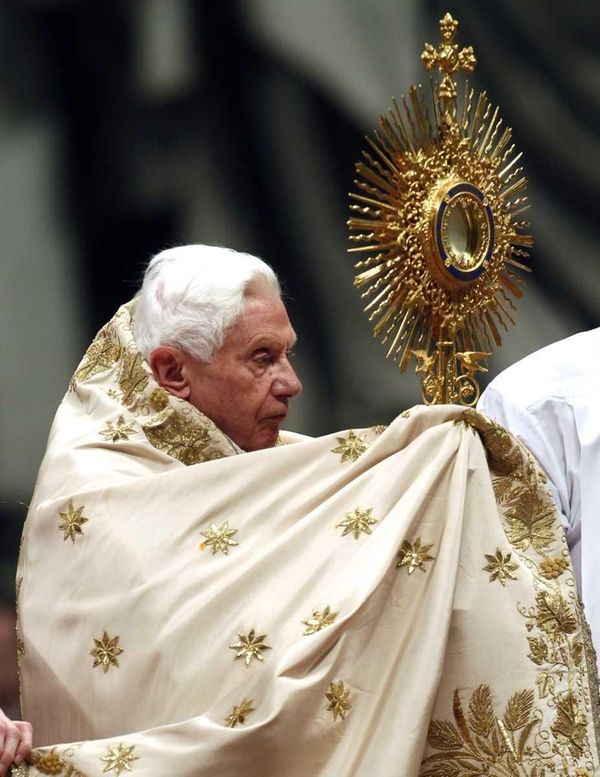
After the strong season of the liturgical year which, focusing on Easter spreads over three months - first the 40 days of Lent, then the 50 days of Eastertide -, the liturgy has us celebrate three Feasts which instead have a "synthetic" character: the Most Holy Trinity, then Corpus Christi, and lastly, the Sacred Heart of Jesus. What is the precise significance of today's Solemnity, of the Body and Blood of Christ? The answer is given to us in the fundamental actions of this celebration we are carrying out: first of all we gather around the altar of the Lord, to be together in his presence; secondly, there will be the procession, that is walking with the Lord; and lastly, kneeling before the Lord, adoration, which already begins in the Mass and accompanies the entire procession but culminates in the final moment of the Eucharistic Blessing when we all prostrate ourselves before the One who stooped down to us and gave his life for us. Let us reflect briefly on these three attitudes, so that they may truly be an expression of our faith and our life.

The first action, therefore, is to gather together in the Lord's presence. This is what in former times was called "statio". Let us imagine for a moment that in the whole of Rome there were only this one altar and that all the city's Christians were invited to gather here to celebrate the Saviour who died and was raised. This gives us an idea of what the Eucharistic celebration must have been like at the origins, in Rome and in many other cities that the Gospel message had reached. In every particular Church there was only one Bishop and around him, around the Eucharist that he celebrated, a community was formed, one, because one was the blessed Cup and one was the Bread broken, as we heard in the Apostle Paul's words in the Second Reading (cf. I Cor 10: 16-17). That other famous Pauline expression comes to mind: "There is neither Jew nor Greek, there is neither slave nor free, there is neither male nor female; for you are all one in Christ Jesus" (Gal 3: 28). "You are all one"! In these words the truth and power of the Christian revolution is heard, the most profound revolution of human history, which was experienced precisely around the Eucharist: here people of different age groups, sex, social background, and political ideas gather together in the Lord's presence. The Eucharist can never be a private event, reserved for people chosen through affinity or friendship. The Eucharist is a public devotion that has nothing esoteric or exclusive about it. Here too, this evening, we did not choose to meet one another, we came and find ourselves next to one another, brought together by faith and called to become one body, sharing the one Bread which is Christ. We are united over and above our differences of nationality, profession, social class, political ideas: we open ourselves to one another to become one in him. This has been a characteristic of Christianity from the outset, visibly fulfilled around the Eucharist, and it is always necessary to be alert to ensure that the recurring temptations of particularism, even if with good intentions, do not go in the opposite direction. Therefore Corpus Christi reminds us first of all of this: that being Christian means coming together from all parts of the world to be in the presence of the one Lord and to become one with him and in him.

The second constitutive aspect is walking with the Lord. This is the reality manifested by the procession that we shall experience together after Holy Mass, almost as if it were naturally prolonged by moving behind the One who is the Way, the Journey. With the gift of himself in the Eucharist the Lord Jesus sets us free from our "paralyses", he helps us up and enables us to "proceed ", that is, he makes us take a step ahead and then another step, and thus sets us going with the power of the Bread of Life. As happened to the Prophet Elijah who had sought refuge in the wilderness for fear of his enemies and had made up his mind to let himself die (cf. I Kgs 19: 1-4). But God awoke him from sleep and caused him to find beside him a freshly baked loaf: "Arise and eat", the angel said, "else the journey will be too great for you" (I Kgs 19: 5,7). The Corpus Christi procession teaches us that the Eucharist seeks to free us from every kind of despondency and discouragement, wants to raise us, so that we can set out on the journey with the strength God gives us through Jesus Christ. It is the experience of the People of Israel in the exodus from Egypt, their long wandering through the desert, as the First Reading relates. It is an experience which was constitutive for Israel but is exemplary for all humanity. Indeed the saying: "Man does not live by bread alone, but... by everything that proceeds out of the mouth of the Lord" (Dt 8: 3), is a universal affirmation which refers to every man or woman as a person. Each one can find his own way if he encounters the One who is the Word and the Bread of Life and lets himself be guided by his friendly presence. Without the God-with-us, the God who is close, how can we stand up to the pilgrimage through life, either on our own or as society and the family of peoples? The Eucharist is the Sacrament of the God who does not leave us alone on the journey but stays at our side and shows us the way. Indeed, it is not enough to move onwards, one must also see where one is going! "Progress" does not suffice, if there are no criteria as reference points. On the contrary, if one loses the way one risks coming to a precipice, or at any rate more rapidly distancing oneself from the goal. God created us free but he did not leave us alone: he made himself the "way" and came to walk together with us so that in our freedom we should also have the criterion we need to discern the right way and to take it.

At this point we cannot forget the beginning of the "Decalogue", the Ten Commandments, where it is written: "I am the Lord your God, who brought you out of the land of Egypt, out of the house of bondage. You shall have no other gods before me" (Ex 20: 2-3). Here we find the meaning of the third constitutive element of Corpus Christi: kneeling in adoration before the Lord. Adoring the God of Jesus Christ, who out of love made himself bread broken, is the most effective and radical remedy against the idolatry of the past and of the present. Kneeling before the Eucharist is a profession of freedom: those who bow to Jesus cannot and must not prostrate themselves before any earthly authority, however powerful. We Christians kneel only before God or before the Most Blessed Sacrament because we know and believe that the one true God is present in it, the God who created the world and so loved it that he gave his Only Begotten Son (cf. Jn 3: 16). We prostrate ourselves before a God who first bent over man like the Good Samaritan to assist him and restore his life, and who knelt before us to wash our dirty feet. Adoring the Body of Christ, means believing that there, in that piece of Bread, Christ is really there, and gives true sense to life, to the immense universe as to the smallest creature, to the whole of human history as to the most brief existence. Adoration is prayer that prolongs the celebration and Eucharistic communion and in which the soul continues to be nourished: it is nourished with love, truth, peace; it is nourished with hope, because the One before whom we prostrate ourselves does not judge us, does not crush us but liberates and transforms us.

This is why gathering, walking and adoring together fills us with joy. In making our own the adoring attitude of Mary, whom we especially remember in this month of May, let us pray for ourselves and for everyone; let us pray for every person who lives in this city, that he or she may know you, O Father and the One whom you sent, Jesus Christ and thus have life in abundance. Amen.

POPE BENEDICT XVI
Homily, Corpus Christi Mass and Procession
May 22, 2008

Tuesday, June 14, 2011

Pope Benedict XVI: PENTECOST, "Two great images of the mission of the Holy Spirit"


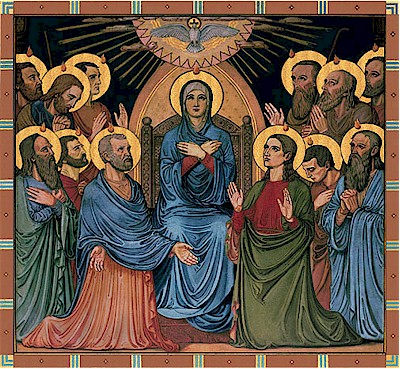
The First Reading and the Gospel of Pentecost Sunday offer us two great images of the mission of the Holy Spirit. The reading from the Acts of the Apostles speaks of how, on the day of Pentecost, under the signs of a strong wind and fire, the Holy Spirit sweeps into the community of the disciples of Jesus who are in prayer, thus bringing the Church into being.

For Israel, Pentecost - celebration of the harvest - had become the celebration marking the conclusion of the Covenant on Mt Sinai. In wind and fire, God made his presence known to the people and then gave them the gift of his Law, the Ten Commandments. In this singular way was the work of liberation, begun with the Exodus from Egypt, brought to fulfilment: human freedom is always a shared freedom, a "togetherness" of liberty. Common freedom lasts only in an ordered harmony of freedom that reveals to each person his or her limits.

In this way the gift of the Law on Mt Sinai was not a restriction nor an abolition of freedom, but the foundation of true liberty. And since a correct human ordering finds stability only if it comes from God and if it unites men and women in the perspective of God, the Commandments that God himself gives us cannot be lacking in a correct ordering of human freedom.

In this way, Israel fully became a people, through the Covenant with God on Mt Sinai. Israel's encounter with God on Sinai could be considered to be the foundation and the guarantee of its existence as a people. The wind and fire, which enveloped the community of Christ's disciples gathered in the Upper Room, becomes a further development of the event of Mt Sinai and gives it new fullness.

They were gathered in Jerusalem on that day, according to what is written in the Acts of the Apostles: "devout Jews of every nation under heaven" (Acts 2: 5). Here is made manifest the characteristic gift of the Holy Spirit: all understood the words of the Apostles: "each one heard these men speaking his own language" (Acts 2: 6). The Holy Spirit gives understanding.

Overcoming the "breach" begun in Babel - the confusion of hearts, putting us one against the other - the Spirit opens borders.

The People of God who found its first configuration on Mt Sinai, now becomes enlarged to the point of recognizing no limitations. The new People of God, the Church, is a people that derives from all peoples. The Church is catholic from her beginning and this is her deepest essence.

St Paul explains and underlines this in the Second Reading when he says: "It was in one Spirit that all of us, whether Jew or Greek, slave or free, were baptized into one body. All of us have been given to drink of the one Spirit" (I Cor 12: 13).

The Church must always become anew what she already is; she must open the borders between peoples and break down the barriers between class and race. In her, there cannot be those who are forgotten or looked down upon. In the Church there are only free brothers and sisters of Jesus Christ. The wind and fire of the Holy Spirit must continually break down those barriers that we men and women continue to build between us; we must continually pass from Babel - being closed in on ourselves - to Pentecost.

Thus, we must continually pray that the Holy Spirit opens us and gives us the grace of understanding, so that we become the People of God deriving from all peoples. St Paul tells us more along these lines: in Christ, who as the one Bread feeds all of us in the Eucharist and draws us to him in his Body wracked on the Cross, we must become only one body and one spirit.

The second image of the sending of the Spirit that we find in the Gospel is much more hidden. Exactly in this way, however, all of the greatness of the Pentecost event is perceived. The Risen Lord passes through the closed doors and enters the place where the disciples are, and greets them twice with the words: "Peace be with you".

We continually close our doors; we continually want to feel secure and do not want to be disturbed by others and by God. And so, we can continually implore the Lord just for this, that he come to us, overcoming our closure, to bring us his greeting: "Peace be with you".

This greeting of the Lord is a bridge that he builds between heaven and earth. He descends to this bridge, reaching us, and we can climb up on this bridge of peace to reach him. On this bridge, always together with him, we too must reach our neighbour, reach the one who needs us. It is in lowering ourselves, together with Christ, that we rise up to him and up to God. God is Love, and so the descent, the lowering that love demands of us, is at the same time the true ascent. Exactly in this way, lowering ourselves, coming out of ourselves, we reach the dignity of Jesus Christ, the human being's true dignity.

The Lord's greeting of peace is followed by two gestures that are decisive for Pentecost: the Lord wants the disciples to continue his mission: "As the Father has sent me, so I send you" (Jn 20: 21).

After this, he breathes on them and says: "Receive the Holy Spirit. If you forgive men's sins, they are forgiven them; if you hold them bound, they are held bound" (Jn 20: 23). The Lord breathes on the disciples, giving them the Holy Spirit, his own Spirit. The breath of Jesus is the Holy Spirit.

We recognize here, in the first place, an allusion made to the story of creation in the Book of Genesis, where it is written: "The Lord God formed man out of the clay of the ground and blew into his nostrils the breath of life" (Gn 2: 7). Man is this mysterious creature who comes entirely from the earth, but in whom has been placed the breath of God. Jesus breathes on the Apostles and gives them the breath of God in a new and greater way.

In people, notwithstanding all of their limitations, there is now something absolutely new: the breath of God. The life of God lives in us. The breath of his love, of his truth and of his goodness. In this way we can see here too an allusion to Baptism and Confirmation, this new belonging to God that the Lord gives to us. The Gospel Reading invites us to this: to live always within the breath of Jesus Christ, receiving life from him, so that he may inspire in us authentic life, the life that no death may ever take away.

To his breath, to the gift of the Holy Spirit, the Lord joins the power of forgiveness. We heard earlier that the Holy Spirit unites, breaks down barriers, leads us one to the other. The strength that opens up and overcomes Babel is the strength of forgiveness.

Jesus can grant forgiveness and the power to forgive because he himself suffered the consequences of sin and dispelled them in the flame of his love. Forgiveness comes from the Cross; he transforms the world with the love that is offered. His heart opened on the Cross is the door through which the grace of forgiveness enters into the world. And this grace alone is able to transform the world and build peace.

If we compare the two events of Pentecost - the strong wind of the 50th day and the gentle breath of Jesus on the evening of Easter - we might think about this contrast between the two episodes that took place on Mt Sinai, spoken of in the Old Testament.

On the one hand, there is the narration of fire, thunder and wind, preceding the promulgation of the Ten Commandments and the conclusion of the Covenant (cf. Ex 19 ff.); on the other, there is the mysterious narration of Elijah on Mt Horeb. Following the dramatic events on Mt Carmel, Elijah fled from the wrath of Ahab and Jezebel. Following God's orders, he journeyed to Mt Horeb. The gift of the holy Covenant, of faith in the one God, seemed to have disappeared from Israel.

In a certain way, Elijah must rekindle the flame of faith on God's mountain and bring it back to Israel. He experiences, in that place, wind, earthquake and fire. But God is not present in all of this. He then perceives a sweet soft murmur; and God speaks to him in this soft breath (cf. I Kings 19: 11-18).

Is this not precisely what takes place the evening of Easter, when Jesus appeared to his Apostles to teach them what it means here? Might we perhaps see here a prefiguration of the servant of Yahweh, of whom Isaiah says: "He will not cry or lift up his voice, or make it heard in the street" (42: 2)? Does not the humble figure of Jesus appear this way, as the true revelation in whom God manifests himself and speaks to us? Are not the humility and goodness of Jesus the true epiphany of God?

On Mt Carmel, Elijah sought to overcome the distancing from God with fire and the sword, killing the prophets of Baal. In this way, though, he was unable to restore the faith.

On Mt Horeb, he was made to understand that God is not in the wind, the earthquake or the fire; Elijah has to learn and perceive the soft voice of God, and in this way to recognize in advance the One who overcame sin not with power but by his Passion; the One who, by his suffering, has given us the ability to forgive. This is how God wins.

Dear Ordinandi, in this way the message of Pentecost is now aimed directly at you. The Pentecostal scene of the Gospel of John speaks to you and of you. To each one of you, in a very personal way, the Lord says: Peace to [all of] you - peace to you! When the Lord says this, he does not give something, but he gives himself. Indeed, he himself is peace (cf. Eph 2: 14).

In this greeting of the Lord, we can also foresee a reference to the great mystery of faith, to the Holy Eucharist, in which he continually gives himself to us, and, in this way, true peace.
Sacrament of the Eucharist

This greeting is placed at the centre of your priestly mission: the Lord entrusts to you the mystery of this Sacrament. In his Name you can say: "This is my Body.... This is my Blood". Allow yourselves to be drawn ever anew by the Holy Eucharist, by communion of life with Christ. Consider the centre of each day the possibility to celebrate the Eucharist worthily. Lead people ever anew to this mystery. Help them, starting from this, to bring the peace of Christ into the world.

In the Gospel Reading we have just heard, a second phrase of the Risen One resounds: "As the Father has sent me, so I send you" (Jn 20: 21). Christ says this in a very personal way to each one of you.

With priestly ordination you are inserted into the Apostolic mission. The Holy Spirit is wind, but it is not amorphous; it is an orderly Spirit. It becomes manifest precisely when it orders the mission, in the Sacrament of the Priesthood, in which the ministry of the Apostles is continued.

Through this ministry, you are inserted in the multitude of those who, beginning with Pentecost, have received the apostolic mission. You are inserted into the communion of priests, into communion with the Bishop and with the Successor of St Peter, who here in Rome is also your Bishop. All of us are inserted in the network of obedience to the Word of Christ, to the word of the One who gives us true freedom because he leads us in the free spaces and open horizons of the truth.

It is precisely in this common bond with the Lord that we can and must live the dynamism of the Spirit. As the Lord came from the Father and has given us light, life and love, so too the mission must continually set us in motion, make us restless, to bring the joy of Christ to those who suffer, those who are in doubt, as well as to the reluctant.

Lastly, there is the power of forgiveness. The Sacrament of Penance is one of the Church's precious treasures, since authentic world renewal is accomplished only through forgiveness. Nothing can improve the world if evil is not overcome.

Evil can be overcome only by forgiveness. Certainly, it must be an effective forgiveness; but only the Lord can give us this forgiveness, a forgiveness that drives away evil not only with words but truly destroys it. Only suffering can bring this about and it has truly taken place with the suffering love of Christ, from whom we draw the power to forgive.

In closing, dear Ordinandi, I recommend that you love the Mother of the Lord. Do as St John did, welcoming her deeply into your own heart. Allow yourselves to be continually renewed by her maternal love. Learn from her how to love Christ. May the Lord bless your journey as priests!

Amen.

HOMILY OF HIS HOLINESS BENEDICT XVI
St Peter's Basilica
Pentecost Sunday, 15 May 2005

Monday, June 13, 2011

Pope Benedict XVI: PENTECOST, Birth of the Church

Dear Brothers and Sisters,

Today, we celebrate the great feast of Pentecost, in which the liturgy has us relive the birth of the Church, according to what St Luke narrates in the book of the Acts of the Apostles (2: 1-13).

Fifty days after Easter, the Holy Spirit descended on the community of disciples - "with one accord devoted themselves to prayer" - gathered with "Mary, the mother of Jesus" and with the Twelve Apostles (cf. Acts 1: 14; 2: 1). We can therefore say that the Church had its solemn beginning with the descent of the Holy Spirit.

In this extraordinary event we find the essential and qualifying characteristics of the Church: the Church is one, like the community at Pentecost, who were united in prayer and "concordant": "were of one heart and soul" (Acts 4: 32).

The Church is holy, not by her own merits, but because, animated by the Holy Spirit, she keeps her gaze on Christ, to become conformed to him and to his love.

The Church is catholic, because the Gospel is destined for all peoples, and for this, already at the beginning, the Holy Spirit made her speak all languages.

The Church is apostolic, because, built upon the foundation of the Apostles, she faithfully keeps their teaching through the uninterrupted chain of episcopal succession.

What is more, the Church by her nature is missionary, and from the day of Pentecost the Holy Spirit does not cease to move her along the ways of the world to the ends of the earth and to the end of time.

This reality, which we can verify in every epoch, is already anticipated in the Book of Acts, where the Gospel passage from the Hebrews to the pagans, from Jerusalem to Rome, is described. Rome represents the pagan world, and hence, all people who are outside of the ancient People of God. Actually, Acts concludes with the arrival of the Gospel to Rome.

It can be said, then, that Rome is the concrete name of catholicity and missionary spirit, it expresses fidelity to the origins, to the Church of all times, to a Church that speaks all languages and extends herself to all cultures.

Dear brothers and sisters, the first Pentecost took place when Mary Most Holy was present amid the disciples in the Upper Room in Jerusalem and prayed. Today, too, let us entrust ourselves to her maternal intercession, so that the Holy Spirit may descend in abundance upon the Church in our day, fill the hearts of all the faithful and enkindle in them the fire of his love.

REGINA CƆLI
Saint Peter's Square
Pentecost Sunday, 27 May 2007

Sunday, June 12, 2011

Pope Benedict XVI: PENTECOST II

It was precisely this that Jesus promised his disciples in the last days of his earthly mission, as we have just heard in the Gospel passage: he assured them of the help of the Holy Spirit that he would send to continue to make them aware of his presence (cf. Jn 14: 16-17). This promise became reality when, after the Resurrection, Jesus entered the Upper Room, greeted the disciples with the words, "Peace be with you", and breathing on them said: "Receive the Holy Spirit" (Jn 20: 22). He authorized them to forgive sins. Here, therefore, the Holy Spirit, appears as a power for the forgiveness of sins, for renewing our hearts and our lives; and thus he renews the earth and creates unity where there was division. Furthermore, on the Feast of Pentecost the Holy Spirit showed himself in other signs: in the sign of a mighty wind, tongues of fire, and the Apostles' ability to speak all languages. This was a sign that the Babylonian dispersion, the result of pride that separates men and women, had been overcome in the Spirit who is love and gives unity in diversity. Since the very first moment of her existence the Church has spoken in all languages - thanks to the power of the Holy Spirit and the tongues of fire - and has lived in all cultures, she does not destroy any of the various gifts, of the different charisms, but draws all of them together in a great, new unity that reconciles: unity and multiformity.

The Holy Spirit, who is eternal charity, the bond of unity in the Trinity, with his power of divine charity unites scattered humanity thereby creating the vast multiform community of the Church throughout the world. In the days following the Ascension of the Lord until Pentecost Sunday, the disciples, with Mary, were gathered in the Upper Room to pray. They knew that they themselves could not create or organize the Church: the Church had to be born and organized by divine initiative; she is not created by us, she is a gift of God. And this is likewise the only way in which she creates unity, a unity that must grow. The Church in every time - and particularly in these nine days between the Ascension and Pentecost - is spiritually united in the Upper Room with the Apostles and Mary to ceaselessly implore the outpouring of the Holy Spirit. Driven onwards by his mighty wind she will thus be able to proclaim the Gospel to the very ends of the earth.

This is why even in the face of difficulties and divisions, Christians cannot be resigned nor yield to discouragement. The Lord asks this of us: to persevere in prayer in order to keep alive the flame of faith, love and hope which nourishes the desire for full unity. "Ut unum sint!", says the Lord. May Christ's invitation always resound in our hearts, an invitation I was able to relaunch on my recent Apostolic Journey in the United States of America, when I referred to the centrality of prayer in the ecumenical movement. In this epoch of globalization and at the same time of fragmentation, "without [prayer], ecumenical structures, institutions and programs would be deprived of their heart and soul" (Ecumenical Prayer Service and Meeting, St Joseph's Church, New York, 18 April 2008). Let us give thanks to the Lord for the goals reached in ecumenical dialogue thanks to the Holy Spirit's action; let us be docile, listening to his voice so that our hearts, filled with hope, may continuously seek the path that leads to the full communion of all Christ's disciples.

In his Letter to the Galatians, St Paul recalls that "the fruit of the Spirit is love, joy, peace, patience, kindness, goodness, faithfulness, gentleness, self-control" (Gal 5: 22-23). These are the gifts of the Holy Spirit that we also implore today for all Christians, so that in the common and generous service to the Gospel, they may be a sign of God's love for humanity in the world. Let us turn our gaze confidently to Mary, the Shrine of the Holy Spirit and through her pray: "Come, Holy Spirit, fill the hearts of your faithful and kindle in them the fire of your love". Amen.

GENERAL AUDIENCE
St Peter's Square
Wednesday, 7 May 2008

Saturday, June 11, 2011

Pope Benedict XVI: PENTECOST


Dear Brothers and Sisters, 

Today we are celebrating the Solemnity of Pentecost, an ancient Jewish feast on which the Covenant that God made with his People on Mount Sinai (cf. Ex 19) was commemorated. It also became a Christian feast because of what happened on that day 50 days after Jesus' Pasch. We read in the Acts of the Apostles that the disciples were praying all together in the Upper Room when the Holy Spirit descended upon them powerfully, as wind and as fire. They then began to proclaim in many tongues the Good News of Christ's Resurrection (cf. 2: 1-4). This was the "Baptism of the Holy Spirit" which had been foretold by John the Baptist: "I baptize you with water", he said to the crowds, "but he who is coming after me is mightier than I... he will baptize you with the Holy Spirit and with fire" (Mt 3: 11). In fact, Jesus' entire mission aimed at giving the Spirit of God to men and women and at baptizing them in his regenerative "bath". This was brought about with his glorification (cf. Jn 7: 39), that is, through his death and Resurrection: then the Spirit of God was poured out in superabundance, like a cascade capable of purifying every heart, extinguishing the fire of evil and kindling the flame of divine love in the world. 

The Acts of the Apostles present Pentecost as the fulfilment of this promise and hence as the culmination of Jesus' entire mission. After his Resurrection, he himself ordered the disciples to stay in Jerusalem, because, he said, "before many days you shall be baptized with the Holy Spirit" (Acts 1: 5); and he added: "You shall receive power when the Holy Spirit has come upon you; and you shall be my witnesses in Jerusalem and in all Judea and Samaria and to the end of the earth" (Acts 1: 8). Thus Pentecost is in a special way the Baptism of the Church which carries out her universal mission starting from the roads of Jerusalem with the miraculous preaching in humanity's different tongues. In this Baptism of the Holy Spirit the personal and community dimension, the "I" of the disciple and the "we" of the Church, are inseparable. The Holy Spirit consecrates the person and at the same time makes him or her a living member of the Mystical Body of Christ, sharing in the mission of witnessing to his love. And this takes place through the Sacraments of Christian initiation:  Baptism and Confirmation. In my Message for the next World Youth Day 2008, I have proposed to the young people that they rediscover the Holy Spirit's presence in their lives and thus the importance of these Sacraments. Today I would like to extend the invitation to all:  let us rediscover, dear brothers and sisters, the beauty of being baptized in the Holy Spirit; let us recover awareness of our Baptism and our Confirmation, ever timely sources of grace. 

Let us ask the Virgin Mary to obtain also today a renewed Pentecost for the Church that will imbue in all, and especially in the young, the joy of living and witnessing to the Gospel. 

REGINA CƆLI
St Peter's Square
Sunday, 11 May 2008