Monday, May 23, 2011

MAY DEVOTION: Day Twenty-Three - Mary Meets Jesus Carrying the Cross


23rd Day — Mary Meets Jesus Carrying the Cross

Bearing His own cross He went forth to that place which is called Calvary. (St. John xix. 17.)

I. As the time of the Passion drew near, Mary's realization of the approaching sufferings of her Son became more vivid. The sword of Simeon pierced her heart as it had never done before. How could she endure to see her Son and her God outraged and ill-treated, insulted, and put to death? "Weeping, she hath wept in the night: there is none to comfort her among all them that were dear to her." (Lament, i. 2.)

2. At last the storm of anguish burst upon her. The apostles bring her the heart-breaking news: He has been seized by the Pharisees, insulted by the soldiers, dragged before Pilate, scourged, and condemned to the death of the cross. What a night and morning for the Mother of Jesus! Each moment full of an agony worse than death.

3. At last she could refrain no longer. She must go and meet Him Whom her soul loved. What a meeting must that have been! Her darling Son all masked in blood, toiling under the weight of the cross. Oh, holy Mother, who would not be moved with compassion? "Attend, and see if there be any sorrow like to my sorrow." (Lament, i. 12.)

O thou Mother! fount of love!
Touch my spirit from above.
Make my heart with thine accord;
Make me feel as thou hast felt;
Make my soul to glow and melt
With the love of Christ my Lord.

Sunday, May 22, 2011

MAY DEVOTION: Day Twenty-Two - Mary during Our Lord's Public Life


22nd Day – Mary during Our Lord's Public Life

Whoever shall do the will of My Father that is in heaven: he is My brother, and sister, and mother. (St. Matt. xii. 50.)

I. When Our Lord left the cottage at Nazareth and went forth to enter on His public ministry, what an aching void must have been left in Mary's heart! How her heart must have yearned to be with Him! Earth was indeed for her a barren waste as long as He was away. Have we any of this love of the company of Jesus? Any desire to seek Him out where He awaits us in the tabernacle, that we may enjoy sweet intercourse with Him?

2. Yet Mary murmured not. She was willing to sacrifice for the good of others even the solace of Jesus' presence. She knew that by her obedience she would be united to Him in bonds far more intimate than the bonds of the closest earthly union. Therefore in joy and in sorrow, in consolation and desolation, whether Christ was with her or far away, her only desire was to submit to the holy will of God.

3. Mary by her prayers and tears and intercession took part in Our Lord's work. He had decreed that His Mother thus should help Him in His public ministry. Though He could do all, He left something for her to do, as He does for all the saints. What a happiness and privilege this! I, too, can take my part in the redemption of mankind!

Queen of sorrows, guide and guard me,
Let me to thine arms repair;
In thy tender bosom hide me,
Mary, take me to thy care!

Saturday, May 21, 2011

MAY DEVOTION: Day Twenty-One - Mary at Cana


21st Day — Mary at Cana

Whatsoever He shall say to you, do ye. (St. John ii. 5.)

1. Jesus' first miracle was performed at the marriage-feast at Cana. Thither Mary was invited, and from the words of the Gospel it seems as if Jesus was invited because His Mother had been already asked. Thus we learn that where Mary comes Jesus is sure to come also. He who entertains her with love and devotion will find that the love of Jesus will soon spring up in his heart.

2. During the marriage-feast the wine runs short. Our Lady notices it; it grieves her; she appeals to her Son in a model prayer. She simply states the need, and leaves all else to Him: "They have no wine." Like this should be our prayers. Jesus likes us to tell Him our needs; He knows them, but He makes prayer a condition of fulfilling our desires.

3. Jesus' words at first seem a rebuke: "Woman, what is it to Me, and to thee?" He often pretends to turn a deaf car to us. How does Mary behave under the seeming slight ? She regards it as a sign that He will grant her request, and turning to the servants bids them obey Him in all things. "Whatsoever He shall say to you, do ye." Mary knew that it is to the submissive and obedient that Christ gives His best gifts. May the most blessed and holy will of God be done in all things! Amen.

My Lord, my God, what wiliest Thou?
Thy blessed will is mine!

Friday, May 20, 2011

MAY DEVOTION: Day Twenty - The Death of Saint Joseph


20th Day — The Death of St. Joseph

Precious in the sight of the Lord is the death of His saints. (Psalm cxv. 15.)

1. For nigh thirty years Joseph had been the faithful spouse of Mary, the gentle foster-father of Jesus. But now the time came for him to die. How tenderly Mary nursed him in his failing strength! How she delighted in supplying all his wants, in ministering to them during the day, in watching by his side during the night! What a model to us who often grow weary with the long sickness of some invalid whom we are tending!

2. St. Joseph's death! Model of a happy death! What joy to die in the arms of Jesus and Mary! To be consoled by the Queen of heaven! To receive the last blessing from God Incarnate! No wonder that he is the patron of a happy death, since from the beginning of the world there was none whose death was surrounded with such glorious privileges and blessings as his.

3. How had Joseph procured so happy a death?

(a)   By waiting for God's guidance in all his actions and promptly following it.
(b)   By his devotion to Mary and to Jesus.  
(c)    By his patience, meekness, prudence, gentleness, purity.

Imitate St. Joseph. Pray to him for a happy death.

Jesus, Mary, and Joseph, I give you my heart and my soul!
Jesus, Mary, and Joseph, assist me in my last agony!
Jesus, Mary, and Joseph, may I die in peace in your blessed company!

Thursday, May 19, 2011

MAY DEVOTION: Day Nineteen - Mary's Loss of Jesus for Three Days


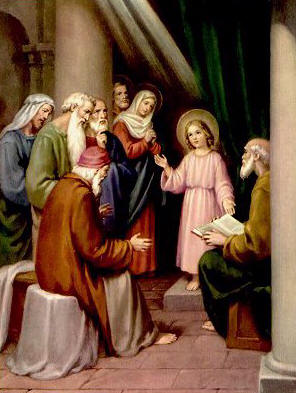
19th Day — Mary's Loss of Jesus for Three Days

Thy father and I have sought Thee sorrowing. (St. Luke ii. 48.)

1. When Jesus was twelve years old, He went up with His parents for their annual visit to the Temple. On their return they missed Him, and for three days sought Him, and sought Him in vain. What must have been the agony of Mary's heart during those three days! Had Jesus left them never to return? Could it be that she had unconsciously, by some negligence, forfeited the privilege of the company of Jesus? Was she never to behold Him again? Such were thoughts that occurred to her in the piercing anguish of her heart. Let us compassionate the holy Mother of God in her desolation.

2. What a cruel void in Mary's heart! The light of her eyes and the joy of her heart had gone from her. What an utter blank all else seemed without Jesus — how could she live without Him? Without Him life would be death. "How shall I comfort thee, O Virgin daughter of Sion? For great as an ocean is thy sorrow."

3. Mary, then, can understand our sorrow in times of darkness and desolation. No blackness of desolation in our hearts is ever like the desolation of Mary — when she had lost Jesus. In all our anguish we will cry to her. She will not be deaf to our despairing cry, but will most surely succor us and restore to us peace and joy, as to her there returned peace and joy unspeakable when she found her divine Son in the Temple.

Mother of sorrows, pray for us !
Hear, sweet Mother, hear the weary,
Borne upon life's troubled sea!

Wednesday, May 18, 2011

MAY DEVOTION: Day Eighteen - Mary's Life at Nazareth


18th Day — Mary's Life at Nazareth

Besides Thee what do I desire upon earth? (Psalm Ixxii. 25.)

1. When the holy family returned from Egypt, they took up their abode in a little cottage at Nazareth. Yet that cottage was the closest approximation to heaven upon earth that ever has been or ever can be found. There dwelt the omnipotent God, the Queen of heaven, the protector of the whole Church of God. This poor and humble dwelling was chosen by almighty God as the most suitable abode for those He loved best.

2. What an unspeakable joy and consolation it must have been to Mary to dwell for those years in familiar conversation with Jesus! To carry in her arms her God, hers as He was none other's, flesh of her flesh, bone of her bone! to enjoy His sweet caresses! To hear Him call her Mother! To gaze on the unveiled countenance of God made flesh! What an ecstasy of happiness for Mary!

3. What happiness, too, Mary found in the company of her chaste spouse, St. Joseph! No husband was ever so thoughtful as Joseph, none so gentle, so unselfish. Such a tower of manly strength! What a pleasure it was to her to obey him! How she watches for every expression of his will! How promptly, joyfully, loyally she carries it out! Is this the way I behave to those to whom I am subject?

Oh, nought did Jesus love on earth
So tenderly as thee!

Tuesday, May 17, 2011

Pope Benedict XVI: CHRISTIAN PRAYER


 Christian prayer

Dear Brothers and Sisters,

Today I would like to begin a new series of Catecheses. After the series on the Fathers of the Church, on the great theologians of the Middle Ages and on great women, I would now like to choose a topic that is dear to all our hearts: it is the theme of prayer, and especially Christian prayer, the prayer, that is, which Jesus taught and which the Church continues to teach us. It is in fact in Jesus that man becomes able to approach God in the depth and intimacy of the relationship of fatherhood and sonship. Together with the first disciples, let us now turn with humble trust to the Teacher and ask him: “Lord, teach us to pray” (Lk 11:1).

In the upcoming Catechesis, in comparing Sacred Scripture, the great tradition of the Fathers of the Church, of the Teachers of spirituality and of the Liturgy, let us learn to live our relationship with the Lord, even more intensely as it were at a “school of prayer”.

We know well, in fact, that prayer should not be taken for granted. It is necessary to learn how to pray, as it were acquiring this art ever anew; even those who are very advanced in spiritual life always feel the need to learn from Jesus, to learn how to pray authentically. We receive the first lesson from the Lord by his example. The Gospels describe Jesus to us in intimate and constant conversation with the Father: it is a profound communion of the One who came into the world not to do his will but that of the Father who sent him for the salvation of man.

At this first Catechesis, as an introduction I would like to propose several examples of prayer in the ancient cultures, to show that practically always and everywhere they were addressed to God.

I shall start with ancient Egypt, as an example. Here a blind man, asking the divinity to restore his sight, testifies to something universally human. This is a pure and simple prayer of petition by someone who is suffering. This man prays: “My heart longs to see you.... You who made me see the darkness, create light for me, so that I may see you! Bend your beloved face over me” (A. Barucq — F. Daumas, Hymnes et priĆØres de l’Egypte ancienne, Paris 1980). That I may see you; this is the essence of the prayer!

In the religions of Mesopotamia an arcane, paralyzing sense of guilt predominated, but which was not devoid of the hope of redemption and liberation on God’s part. We may thus appreciate this entreaty by a believer of those ancient cultures, formulated in these words: “O God who are indulgent even in the greatest sin, absolve me from my sin.... Look, O Lord at your tired servant and blow your breeze upon him: forgive him without delay. Alleviate your severe punishment. Freed from bonds, grant that I may breathe anew, break my chains, loosen the fetters that bind me” (M.-J. Seux, Hymnes et PriĆØres aux Dieux de Babylone et d’Assyrie, Paris 1976). These are words that demonstrate how the human being, in his search for God, had intuited, if vaguely, on the one hand his own guilt and on the other, aspects of divine mercy and goodness.

In the pagan religion of ancient Greece, a very significant development may be seen: prayers, while still invoking divine help to obtain heavenly favours in every circumstance of daily life and to receive material benefits, gradually became orientated to more disinterested requests, which enabled the believer to deepen his or her relationship with God and to become a better person.

For example, the great philosopher Plato records a prayer of his teacher, Socrates, held to be one of the founders of Western thought. This was Socrates’ prayer: “Grant to me that I be made beautiful in my soul within, and that all external possessions be in harmony with my inner man. May I consider the wise man rich; and may I have such wealth as only the self-restrained man can bear or endure” (Plato, Phaedrus, English trans.: Loeb, Harold North Fowler). Rather than to possess plenty of money, he wanted above all to be beautiful within and wise.

In the Greek tragedies, sublime masterpieces of the literature of all time which still, after 25 centuries, are read, thought about and performed today, there is a content of prayer which expresses the desire to know God and to worship his majesty. One of these tragedies says: “O Earth’s Upbearer, thou whose throne is Earth, Who’er thou be, O past our finding out, Zeus, be thou Nature’s Law, or Mind of man, Thee I invoke; for, treading soundless paths, To Justice’ goal thou bringest all mortal things” (Euripedes, Trojan Women, 884-886, English trans.: Loeb, Arthur S. Way). God remains somewhat nebulous, nevertheless man knows this unknown god and prays to the one who guides the ways of the world.

Also among the Romans who made up that great Empire in which Christianity first came into being and spread, prayer, even if it is associated with a utilitarian conception and fundamentally associated with the request for divine protection of the life of the civil community, sometimes begins with invocations that are wonderful for the fervour of personal devotion that is transformed into praise and thanksgiving. In the second century A.D., Apuleius, an author of Roman Africa, attested to this. In his writings he expresses his contemporaries’ dissatisfaction with the traditional religion and the desire for a more authentic relationship with God. In his masterpiece, entitled Metamorphoses, a believer addresses these words to a goddess: “You are holy, you are in every epoch a saviour of the human species, you, in your generosity, always help mortals, offer to the wretch in travail the tender affection of a mother. Neither a day nor a night nor even a second pass without you filling it with your benefits” (Apuleius of Madaura, Metamorphoses ix, 25).

In the same period the Emperor Marcus Aurelius — who was also a philosopher who reflected on the human condition — affirmed the need to pray in order to establish a fruitful cooperation between divine action and human action. He wrote in his Meditations: “Who told you that the gods do not help us also in what depends on us? So begin to pray to them and you will see” (Dictionnaire de SpiritualitĆ© xii/2, col. 2213).

This advice of the Emperor philosopher was effectively put into practice by innumerable generations prior to Christ, thereby demonstrating that human life without prayer, which opens our existence to the mystery God, lacks sense and direction. Always expressed in every prayer, in fact, is the truth of the human creature who on the one hand experiences weakness and impoverishment, who therefore addresses his supplication to Heaven, and on the other is endowed with an extraordinary dignity, so that, in preparing to receive the divine Revelation, finds himself able to enter into communion with God.

Dear friends, in these examples of prayer of different epochs and civilizations emerge the human being’s awareness of his creatural condition and of his dependence on Another superior to him and the source of every good. The human being of all times prays because he cannot fail to wonder about the meaning of his life, which remains obscure and discomforting of it is not put in relations to the mystery of God and if his plan for the world.

Human life is a fabric woven of good and of evil, of undeserved suffering and of joy and beauty that spontaneously and irresistibly impel us to ask God for that light and that inner strength which support us on earth and reveal a hope beyond the boundaries of death.

The pagan religions remain an invocation which from the earth awaits a word from Heaven. One of the last great pagan philosophers, who lived fully in the Christian era, Proclus of Constantinople, gives a voice to this expectation, saying: “unknowable, no one contains you. All that we think belongs to you. Our evils and our good come from you, on you our every yearning depends, O Ineffable One, whom our souls feel present, raising to you a hymn of silence” (Hymni, ed. Vogt, Wiesbaden 1957, in Preghiere dell’umanitĆ , op. cit., p. 61).

In the examples of prayer of the various cultures which we have considered, we can see a testimony of the religious dimension and of the desire for God engraved on the heart of every human being, which receives fulfillment and full expression in the Old and in the New Testament. The Revelation, is in fact purifying and brings to its fullness man’s original yearning for God, offering to him, in prayer, the possibility of a deeper relationship with the heavenly Father.

At the beginning of our journey in the “school of prayer” let us now ask the Lord to illumine our minds and hearts so that the relationship with him in prayer may be ever more intense, affectionate and constant. Once again, let us say to him: “Lord, teach us to pray” (Lk 11:1).
  
BENEDICT XVI

GENERAL AUDIENCE
 St. Peter's Square
Wednesday, 4 May 2011