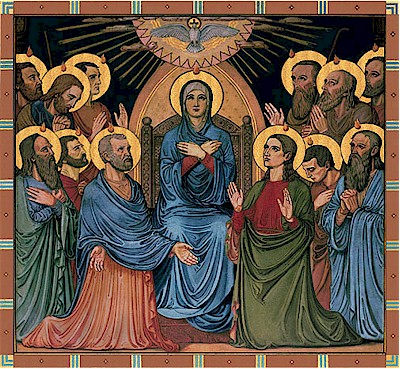
The First Reading and the Gospel of Pentecost Sunday offer us two great images of the mission of the Holy Spirit. The reading from the Acts of the Apostles speaks of how, on the day of Pentecost, under the signs of a strong wind and fire, the Holy Spirit sweeps into the community of the disciples of Jesus who are in prayer, thus bringing the Church into being.
For Israel, Pentecost - celebration of the harvest - had become the celebration marking the conclusion of the Covenant on Mt Sinai. In wind and fire, God made his presence known to the people and then gave them the gift of his Law, the Ten Commandments. In this singular way was the work of liberation, begun with the Exodus from Egypt, brought to fulfilment: human freedom is always a shared freedom, a "togetherness" of liberty. Common freedom lasts only in an ordered harmony of freedom that reveals to each person his or her limits.
In this way the gift of the Law on Mt Sinai was not a restriction nor an abolition of freedom, but the foundation of true liberty. And since a correct human ordering finds stability only if it comes from God and if it unites men and women in the perspective of God, the Commandments that God himself gives us cannot be lacking in a correct ordering of human freedom.
In this way, Israel fully became a people, through the Covenant with God on Mt Sinai. Israel's encounter with God on Sinai could be considered to be the foundation and the guarantee of its existence as a people. The wind and fire, which enveloped the community of Christ's disciples gathered in the Upper Room, becomes a further development of the event of Mt Sinai and gives it new fullness.
They were gathered in Jerusalem on that day, according to what is written in the Acts of the Apostles: "devout Jews of every nation under heaven" (Acts 2: 5). Here is made manifest the characteristic gift of the Holy Spirit: all understood the words of the Apostles: "each one heard these men speaking his own language" (Acts 2: 6). The Holy Spirit gives understanding.
Overcoming the "breach" begun in Babel - the confusion of hearts, putting us one against the other - the Spirit opens borders.
The People of God who found its first configuration on Mt Sinai, now becomes enlarged to the point of recognizing no limitations. The new People of God, the Church, is a people that derives from all peoples. The Church is catholic from her beginning and this is her deepest essence.
St Paul explains and underlines this in the Second Reading when he says: "It was in one Spirit that all of us, whether Jew or Greek, slave or free, were baptized into one body. All of us have been given to drink of the one Spirit" (I Cor 12: 13).
The Church must always become anew what she already is; she must open the borders between peoples and break down the barriers between class and race. In her, there cannot be those who are forgotten or looked down upon. In the Church there are only free brothers and sisters of Jesus Christ. The wind and fire of the Holy Spirit must continually break down those barriers that we men and women continue to build between us; we must continually pass from Babel - being closed in on ourselves - to Pentecost.
Thus, we must continually pray that the Holy Spirit opens us and gives us the grace of understanding, so that we become the People of God deriving from all peoples. St Paul tells us more along these lines: in Christ, who as the one Bread feeds all of us in the Eucharist and draws us to him in his Body wracked on the Cross, we must become only one body and one spirit.
The second image of the sending of the Spirit that we find in the Gospel is much more hidden. Exactly in this way, however, all of the greatness of the Pentecost event is perceived. The Risen Lord passes through the closed doors and enters the place where the disciples are, and greets them twice with the words: "Peace be with you".
We continually close our doors; we continually want to feel secure and do not want to be disturbed by others and by God. And so, we can continually implore the Lord just for this, that he come to us, overcoming our closure, to bring us his greeting: "Peace be with you".
This greeting of the Lord is a bridge that he builds between heaven and earth. He descends to this bridge, reaching us, and we can climb up on this bridge of peace to reach him. On this bridge, always together with him, we too must reach our neighbour, reach the one who needs us. It is in lowering ourselves, together with Christ, that we rise up to him and up to God. God is Love, and so the descent, the lowering that love demands of us, is at the same time the true ascent. Exactly in this way, lowering ourselves, coming out of ourselves, we reach the dignity of Jesus Christ, the human being's true dignity.
The Lord's greeting of peace is followed by two gestures that are decisive for Pentecost: the Lord wants the disciples to continue his mission: "As the Father has sent me, so I send you" (Jn 20: 21).
After this, he breathes on them and says: "Receive the Holy Spirit. If you forgive men's sins, they are forgiven them; if you hold them bound, they are held bound" (Jn 20: 23). The Lord breathes on the disciples, giving them the Holy Spirit, his own Spirit. The breath of Jesus is the Holy Spirit.
We recognize here, in the first place, an allusion made to the story of creation in the Book of Genesis, where it is written: "The Lord God formed man out of the clay of the ground and blew into his nostrils the breath of life" (Gn 2: 7). Man is this mysterious creature who comes entirely from the earth, but in whom has been placed the breath of God. Jesus breathes on the Apostles and gives them the breath of God in a new and greater way.
In people, notwithstanding all of their limitations, there is now something absolutely new: the breath of God. The life of God lives in us. The breath of his love, of his truth and of his goodness. In this way we can see here too an allusion to Baptism and Confirmation, this new belonging to God that the Lord gives to us. The Gospel Reading invites us to this: to live always within the breath of Jesus Christ, receiving life from him, so that he may inspire in us authentic life, the life that no death may ever take away.
To his breath, to the gift of the Holy Spirit, the Lord joins the power of forgiveness. We heard earlier that the Holy Spirit unites, breaks down barriers, leads us one to the other. The strength that opens up and overcomes Babel is the strength of forgiveness.
Jesus can grant forgiveness and the power to forgive because he himself suffered the consequences of sin and dispelled them in the flame of his love. Forgiveness comes from the Cross; he transforms the world with the love that is offered. His heart opened on the Cross is the door through which the grace of forgiveness enters into the world. And this grace alone is able to transform the world and build peace.
If we compare the two events of Pentecost - the strong wind of the 50th day and the gentle breath of Jesus on the evening of Easter - we might think about this contrast between the two episodes that took place on Mt Sinai, spoken of in the Old Testament.
On the one hand, there is the narration of fire, thunder and wind, preceding the promulgation of the Ten Commandments and the conclusion of the Covenant (cf. Ex 19 ff.); on the other, there is the mysterious narration of Elijah on Mt Horeb. Following the dramatic events on Mt Carmel, Elijah fled from the wrath of Ahab and Jezebel. Following God's orders, he journeyed to Mt Horeb. The gift of the holy Covenant, of faith in the one God, seemed to have disappeared from Israel.
In a certain way, Elijah must rekindle the flame of faith on God's mountain and bring it back to Israel. He experiences, in that place, wind, earthquake and fire. But God is not present in all of this. He then perceives a sweet soft murmur; and God speaks to him in this soft breath (cf. I Kings 19: 11-18).
Is this not precisely what takes place the evening of Easter, when Jesus appeared to his Apostles to teach them what it means here? Might we perhaps see here a prefiguration of the servant of Yahweh, of whom Isaiah says: "He will not cry or lift up his voice, or make it heard in the street" (42: 2)? Does not the humble figure of Jesus appear this way, as the true revelation in whom God manifests himself and speaks to us? Are not the humility and goodness of Jesus the true epiphany of God?
On Mt Carmel, Elijah sought to overcome the distancing from God with fire and the sword, killing the prophets of Baal. In this way, though, he was unable to restore the faith.
On Mt Horeb, he was made to understand that God is not in the wind, the earthquake or the fire; Elijah has to learn and perceive the soft voice of God, and in this way to recognize in advance the One who overcame sin not with power but by his Passion; the One who, by his suffering, has given us the ability to forgive. This is how God wins.
Dear Ordinandi, in this way the message of Pentecost is now aimed directly at you. The Pentecostal scene of the Gospel of John speaks to you and of you. To each one of you, in a very personal way, the Lord says: Peace to [all of] you - peace to you! When the Lord says this, he does not give something, but he gives himself. Indeed, he himself is peace (cf. Eph 2: 14).
In this greeting of the Lord, we can also foresee a reference to the great mystery of faith, to the Holy Eucharist, in which he continually gives himself to us, and, in this way, true peace.
Sacrament of the Eucharist
This greeting is placed at the centre of your priestly mission: the Lord entrusts to you the mystery of this Sacrament. In his Name you can say: "This is my Body.... This is my Blood". Allow yourselves to be drawn ever anew by the Holy Eucharist, by communion of life with Christ. Consider the centre of each day the possibility to celebrate the Eucharist worthily. Lead people ever anew to this mystery. Help them, starting from this, to bring the peace of Christ into the world.
In the Gospel Reading we have just heard, a second phrase of the Risen One resounds: "As the Father has sent me, so I send you" (Jn 20: 21). Christ says this in a very personal way to each one of you.
With priestly ordination you are inserted into the Apostolic mission. The Holy Spirit is wind, but it is not amorphous; it is an orderly Spirit. It becomes manifest precisely when it orders the mission, in the Sacrament of the Priesthood, in which the ministry of the Apostles is continued.
Through this ministry, you are inserted in the multitude of those who, beginning with Pentecost, have received the apostolic mission. You are inserted into the communion of priests, into communion with the Bishop and with the Successor of St Peter, who here in Rome is also your Bishop. All of us are inserted in the network of obedience to the Word of Christ, to the word of the One who gives us true freedom because he leads us in the free spaces and open horizons of the truth.
It is precisely in this common bond with the Lord that we can and must live the dynamism of the Spirit. As the Lord came from the Father and has given us light, life and love, so too the mission must continually set us in motion, make us restless, to bring the joy of Christ to those who suffer, those who are in doubt, as well as to the reluctant.
Lastly, there is the power of forgiveness. The Sacrament of Penance is one of the Church's precious treasures, since authentic world renewal is accomplished only through forgiveness. Nothing can improve the world if evil is not overcome.
Evil can be overcome only by forgiveness. Certainly, it must be an effective forgiveness; but only the Lord can give us this forgiveness, a forgiveness that drives away evil not only with words but truly destroys it. Only suffering can bring this about and it has truly taken place with the suffering love of Christ, from whom we draw the power to forgive.
In closing, dear Ordinandi, I recommend that you love the Mother of the Lord. Do as St John did, welcoming her deeply into your own heart. Allow yourselves to be continually renewed by her maternal love. Learn from her how to love Christ. May the Lord bless your journey as priests!
Amen.
HOMILY OF HIS HOLINESS BENEDICT XVI
St Peter's Basilica
Pentecost Sunday, 15 May 2005