Sunday, June 12, 2011

Pope Benedict XVI: PENTECOST II

It was precisely this that Jesus promised his disciples in the last days of his earthly mission, as we have just heard in the Gospel passage: he assured them of the help of the Holy Spirit that he would send to continue to make them aware of his presence (cf. Jn 14: 16-17). This promise became reality when, after the Resurrection, Jesus entered the Upper Room, greeted the disciples with the words, "Peace be with you", and breathing on them said: "Receive the Holy Spirit" (Jn 20: 22). He authorized them to forgive sins. Here, therefore, the Holy Spirit, appears as a power for the forgiveness of sins, for renewing our hearts and our lives; and thus he renews the earth and creates unity where there was division. Furthermore, on the Feast of Pentecost the Holy Spirit showed himself in other signs: in the sign of a mighty wind, tongues of fire, and the Apostles' ability to speak all languages. This was a sign that the Babylonian dispersion, the result of pride that separates men and women, had been overcome in the Spirit who is love and gives unity in diversity. Since the very first moment of her existence the Church has spoken in all languages - thanks to the power of the Holy Spirit and the tongues of fire - and has lived in all cultures, she does not destroy any of the various gifts, of the different charisms, but draws all of them together in a great, new unity that reconciles: unity and multiformity.

The Holy Spirit, who is eternal charity, the bond of unity in the Trinity, with his power of divine charity unites scattered humanity thereby creating the vast multiform community of the Church throughout the world. In the days following the Ascension of the Lord until Pentecost Sunday, the disciples, with Mary, were gathered in the Upper Room to pray. They knew that they themselves could not create or organize the Church: the Church had to be born and organized by divine initiative; she is not created by us, she is a gift of God. And this is likewise the only way in which she creates unity, a unity that must grow. The Church in every time - and particularly in these nine days between the Ascension and Pentecost - is spiritually united in the Upper Room with the Apostles and Mary to ceaselessly implore the outpouring of the Holy Spirit. Driven onwards by his mighty wind she will thus be able to proclaim the Gospel to the very ends of the earth.

This is why even in the face of difficulties and divisions, Christians cannot be resigned nor yield to discouragement. The Lord asks this of us: to persevere in prayer in order to keep alive the flame of faith, love and hope which nourishes the desire for full unity. "Ut unum sint!", says the Lord. May Christ's invitation always resound in our hearts, an invitation I was able to relaunch on my recent Apostolic Journey in the United States of America, when I referred to the centrality of prayer in the ecumenical movement. In this epoch of globalization and at the same time of fragmentation, "without [prayer], ecumenical structures, institutions and programs would be deprived of their heart and soul" (Ecumenical Prayer Service and Meeting, St Joseph's Church, New York, 18 April 2008). Let us give thanks to the Lord for the goals reached in ecumenical dialogue thanks to the Holy Spirit's action; let us be docile, listening to his voice so that our hearts, filled with hope, may continuously seek the path that leads to the full communion of all Christ's disciples.

In his Letter to the Galatians, St Paul recalls that "the fruit of the Spirit is love, joy, peace, patience, kindness, goodness, faithfulness, gentleness, self-control" (Gal 5: 22-23). These are the gifts of the Holy Spirit that we also implore today for all Christians, so that in the common and generous service to the Gospel, they may be a sign of God's love for humanity in the world. Let us turn our gaze confidently to Mary, the Shrine of the Holy Spirit and through her pray: "Come, Holy Spirit, fill the hearts of your faithful and kindle in them the fire of your love". Amen.

GENERAL AUDIENCE
St Peter's Square
Wednesday, 7 May 2008

Saturday, June 11, 2011

Pope Benedict XVI: PENTECOST


Dear Brothers and Sisters, 

Today we are celebrating the Solemnity of Pentecost, an ancient Jewish feast on which the Covenant that God made with his People on Mount Sinai (cf. Ex 19) was commemorated. It also became a Christian feast because of what happened on that day 50 days after Jesus' Pasch. We read in the Acts of the Apostles that the disciples were praying all together in the Upper Room when the Holy Spirit descended upon them powerfully, as wind and as fire. They then began to proclaim in many tongues the Good News of Christ's Resurrection (cf. 2: 1-4). This was the "Baptism of the Holy Spirit" which had been foretold by John the Baptist: "I baptize you with water", he said to the crowds, "but he who is coming after me is mightier than I... he will baptize you with the Holy Spirit and with fire" (Mt 3: 11). In fact, Jesus' entire mission aimed at giving the Spirit of God to men and women and at baptizing them in his regenerative "bath". This was brought about with his glorification (cf. Jn 7: 39), that is, through his death and Resurrection: then the Spirit of God was poured out in superabundance, like a cascade capable of purifying every heart, extinguishing the fire of evil and kindling the flame of divine love in the world. 

The Acts of the Apostles present Pentecost as the fulfilment of this promise and hence as the culmination of Jesus' entire mission. After his Resurrection, he himself ordered the disciples to stay in Jerusalem, because, he said, "before many days you shall be baptized with the Holy Spirit" (Acts 1: 5); and he added: "You shall receive power when the Holy Spirit has come upon you; and you shall be my witnesses in Jerusalem and in all Judea and Samaria and to the end of the earth" (Acts 1: 8). Thus Pentecost is in a special way the Baptism of the Church which carries out her universal mission starting from the roads of Jerusalem with the miraculous preaching in humanity's different tongues. In this Baptism of the Holy Spirit the personal and community dimension, the "I" of the disciple and the "we" of the Church, are inseparable. The Holy Spirit consecrates the person and at the same time makes him or her a living member of the Mystical Body of Christ, sharing in the mission of witnessing to his love. And this takes place through the Sacraments of Christian initiation:  Baptism and Confirmation. In my Message for the next World Youth Day 2008, I have proposed to the young people that they rediscover the Holy Spirit's presence in their lives and thus the importance of these Sacraments. Today I would like to extend the invitation to all:  let us rediscover, dear brothers and sisters, the beauty of being baptized in the Holy Spirit; let us recover awareness of our Baptism and our Confirmation, ever timely sources of grace. 

Let us ask the Virgin Mary to obtain also today a renewed Pentecost for the Church that will imbue in all, and especially in the young, the joy of living and witnessing to the Gospel. 

REGINA CÆLI
St Peter's Square
Sunday, 11 May 2008

Sunday, June 5, 2011

Blessed Pope John Paul the Great: FEAST OF THE LORD'S ASCENSION

"God mounts his throne to shouts of joy" (Responsorial Psalm, Response). These words of today's liturgy lead us into the Solemnity of the Ascension. We relive the moment when Christ returns to the Father, after completing his earthly mission. This feast is the culmination of Christ's glorification at Easter. It is also the immediate preparation for the gift of the Holy Spirit who will come at Pentecost. The Ascension of the Lord should not therefore be taken as an isolated episode but as an integral part of the Easter Mystery.

Indeed the risen Jesus does not leave his disciples definitively; rather, he begins a new kind of relationship with them. If, from the physical and earthly viewpoint, he is no longer present, his invisible presence is nonetheless intensified, reaching a depth and breadth that are absolutely new.

Through the action of the promised Holy Spirit, Jesus was to be present where he had taught his disciples to recognize him:  in the Church, the community of all who were to believe in him, called to carry out a never-ending evangelizing mission down the ages in the Gospel, and the sacraments.

Saturday, June 4, 2011

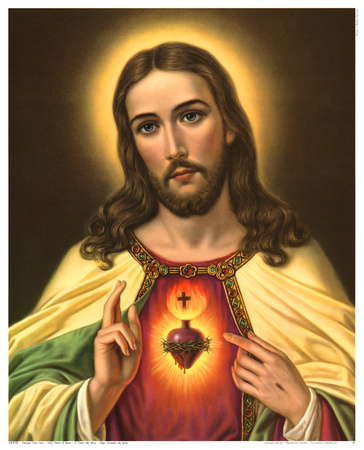
JUNE: Devotion to the Sacred Heart of Jesus IV

On Sunday, June 24, 2002 Pope John Paul II's address before he prayed the Angelus with the faithful in St. Peter's Square explained the devotion to the Sacred Heart as follows:

Dear Brothers and Sisters!

1. The month of June is singled out, in a particular way, for devotion to the Sacred Heart of Jesus. To celebrate the Heart of Christ means to turn toward the profound center of the Person of the Savior, that center which the Bible identifies precisely as his Heart, seat of the love that has redeemed the world.

If the human heart represents an unfathomable mystery that only God knows, how much more sublime is the heart of Jesus, in which the life of the Word itself beats. In it, as suggested by the beautiful Litanies of the Sacred Heart that echo the Scriptures, are found all the treasures of wisdom and science and all the fullness of divinity.

In order to save man, victim of his own disobedience, God wished to give him a "new heart," faithful to his will of love (see Jeremiah 31:33; Ezekiel 36:26; Psalm 50[51]:12). This heart is the heart of Christ, the masterpiece of the Holy Spirit, which began to beat in the virginal womb of Mary and was pierced by the lance on the cross, thus becoming for all the inexhaustible source of eternal life. That Heart is now the pledge of hope for every man.

2. How necessary for contemporary humanity is the message that flows from contemplation of the heart of Christ. Where, indeed, if not from that source will it be able to attain the reserves of meekness and forgiveness necessary to heal the bitter conflicts that bloody it?

Today I would like to entrust in a special way to the merciful heart of Jesus all those who live in the Holy Land: Jews, Christians and Muslims. That Heart that, burdened with insult, never nourished sentiments of hatred and vengeance, but asked for forgiveness for his executioners, that Heart shows the only way to emerge from the spiral of violence: the way of pacification of spirits, of reciprocal understanding and reconciliation.

3. Together with the merciful heart of Christ we venerate the Immaculate Heart of Mary Most Holy, Mediatrix of grace and salvation.

We turn to her now with faith to implore for mercy and peace for the Church and the whole world.

[Translation by ZENIT]

Friday, June 3, 2011

JUNE: Devotion to the Sacred Heart of Jesus III

ANGELUS
Saint Peter's Square
Sunday, 1st June May 2008

Dear Brothers and Sisters,

On this Sunday, which coincides with the beginning of June, I am pleased to recall that this month is traditionally dedicated to the Heart of Christ, symbol of the Christian faith, particularly dear to the people, to mystics and theologians because it expresses in a simple and authentic way the "good news" of love, compendium of the mystery of the Incarnation and Redemption. Last Friday, after the Most Holy Trinity and Corpus Christi, we celebrated the Solemnity of the Sacred Heart of Jesus, the third and last feast following Eastertide. This sequence calls to mind a movement toward the centre: a movement of the spirit which God himself guides. In fact, from the infinite horizon of his love, God wished to enter into the limits of human history and the human condition. He took on a body and a heart. Thus, we can contemplate and encounter the infinite in the finite, the invisible and ineffable Mystery in the human Heart of Jesus, the Nazarene. In my first Encyclical on the theme of love, the point of departure was exactly "contemplating the pierced side of Christ", which John speaks of in his Gospel (cf. 19: 37; Deus Caritas Est, n. 12). And this centre of faith is also the font of hope in which we have been saved, the hope that I made the object of my second Encyclical.

Every person needs a "centre" for his own life, a source of truth and goodness to draw from in the daily events, in the different situations and in the toil of daily life. Every one of us, when he/she pauses in silence, needs to feel not only his/her own heartbeat, but deeper still, the beating of a trustworthy presence, perceptible with faith's senses and yet much more real: the presence of Christ, the heart of the world. Therefore, I invite each one of you to renew in the month of June his/her own devotion to the Heart of Christ, also using the traditional prayer of the daily offering and keeping present the intentions I have proposed for the whole Church.

Next to the Sacred Heart of Jesus, the liturgy invites us to venerate the Immaculate Heart of Mary. With great confidence let us entrust ourselves to her. Once again I would like to invoke the maternal intercession of the Virgin for the populations of China and Myanmar struck by natural calamities and for those who are going through the many situations of pain, sickness, material and spiritual poverty that mark humanity's path.

Thursday, June 2, 2011

JUNE: Devotion to the Sacred Heart of Jesus II

Excerpt from

    Directory on Popular Piety and the Liturgy:
    Principles and Guidelines and the Liturgy
    Congregation for Divine Worship and the Discipline of the Sacraments, December 2001

The Sacred Heart of Jesus

    166. The Church celebrates the Solemnity of the Sacred Heart of Jesus on the Friday following the second Sunday after Pentecost. In addition to the liturgical celebration, many devotional exercises are connected with the Sacred Heart of Jesus. Of all devotions, devotion to the Sacred Heart was, and remains, one of the most widespread and popular in the Church.

    Understood in the light of the Scriptures, the term "Sacred Heart of Jesus" denotes the entire mystery of Christ, the totality of His being, and His person considered in its most intimate essential: Son of God, uncreated wisdom; infinite charity, principal of the salvation and sanctification of mankind. The "Sacred Heart" is Christ, the Word Incarnate, Savior, intrinsically containing, in the Spirit, an infinite divine-human love for the Father and for His brothers.

    167. The Roman Pontiffs have frequently averted to the scriptural basis of devotion to the Sacred Heart of Jesus(182).

    Jesus, who is one with the Father (cf. John 10:30), invites His disciples to live in close communion with Him, to model their lives on Him and on His teaching. He, in turn, reveals Himself as "meek and humble of heart" (Mt 11:29). It can be said that, in a certain sense, devotion to the Sacred Heart of Jesus is a cultic form of the prophetic and evangelic gaze of all Christians on Him who was pierced (cf. John 19:37; Zac 12:10), the gaze of all Christians on the side of Christ, transfixed by a lance, and from which flowed blood and water (cf. John 19:34), symbols of the "wondrous sacrament of the Church"(183).

    The Gospel of Saint John recounts the showing of the Lord's hands and His side to the disciples (cf. John 20:20), and of His invitation to Thomas to put his hand into His side (cf. John 20:27). This event has also had a notable influence on the origin and development of the Church's devotion to the Sacred Heart.

    168. These and other texts present Christ as the paschal Lamb, victorious and slain (cf. Rev 5:6). They were objects of much reflection by the Fathers who unveiled their doctrinal richness. They invited the faithful to penetrate the mysteries of Christ by contemplating the wound opened in His side. Augustine writes: "Access is possible: Christ is the door. It was opened for you when His side was opened by the lance. Remember what flowed out from His side: thus, choose where you want to enter Christ. From the side of Christ as He hung dying upon the Cross there flowed out blood and water, when it was pierced by a lance. Your purification is in that water, your redemption is in that blood"(184).

    169. Devotion to the Sacred Heart was particularly strong during the middle ages. Many renowned for the learning and holiness developed and encouraged the devotion, among them Saint Bernard (+1153), Saint Bonaventure (+ 1274), the mystic Saint Lutgarda (+1246), Saint Mathilda of Marburg (+ 1282), the sainted sisters Mathilda (+ 1299) and Gertrude (+ 1302) of the monastery of Helfta, and Ludolf of Saxony (+ 1380). These perceived in the Sacred Heart a "refuge" in which to recover, the seat of mercy, the encounter with Him who is the source of the Lord's infinite love, the fount from which flows the Holy Spirit, the promised land, and true paradise.

    170. In the modern period devotion to the Sacred Heart of Jesus underwent new developments. At a time when Jansenism proclaimed the rigors of divine justice, the devotion to the Sacred Heart of Jesus served as a useful antidote and aroused in the faithful a love for Our Lord and a trust in His infinite mercy symbolized by His Heart. Saint Francis de Sales (+ 1622) adopted humility, gentleness (cf. Mt 11:29) and tender loving mercy, all aspects of the Sacred Heart, as a model for His life and apostolate. The Lord frequently manifested the abundant mercy of His Heart to Saint Margaret Mary (+ 1690); Saint John Eudes (+ 1680) promoted the liturgical cult of the Sacred Heart, while Saint Claude de la Colombière (+ 1682) and Saint John Bosco (+ 1888) and other saints were avid promoters of devotion to the Sacred Heart.

    171. Devotions to the Sacred Heart of Jesus are numerous. Some have been explicitly approved and frequently recommended by the Apostolic See. Among these, mention should be made of the following:

        * personal consecration, described by Pius XI as "undoubtedly the principal devotional practice used in relation to the Sacred Heart"(185);
      * family consecration to the Sacred Heart, in which the family, by virtue of the Sacrament of Holy Matrimony already participating in the mystery of the unity and love of Christ for the Church, is dedicated to Christ so that He might reign in the hearts of all its members (186);
        * the Litany of the Sacred Heart of Jesus, approved for the whole Church in 1891, which is evidently biblical in character and to which many indulgences have been attached;
        * the act of reparation, a prayer with which the faithful, mindful of the infinite goodness of Christ, implore mercy for the offenses committed in so many ways against His Sacred Heart (187);
        * the pious practice of the first Fridays of the month which derives from the "great promises" made by Jesus to Saint Margaret Mary. At a time when sacramental Communion was very rare among the faithful, the first Friday devotion contributed significantly to a renewed use of the Sacraments of Penance and of the Holy Eucharist. In our own times, the devotion to the first Fridays, even if practiced correctly, may not always lead to the desired spiritual fruits. Hence, the faithful require constant instruction so that any reduction of the practice to mere credulity, is avoided and an active faith encouraged so that the faithful may undertake their commitment to the Gospel correctly in their lives. They should also be reminded of the absolute preeminence of Sunday, the "primordial feast"(188), which should be marked by the full participation of the faithful at the celebration of the Holy Mass.

    172. Devotion to the Sacred Heart is a wonderful historical expression of the Church's piety for Christ, her Spouse and Lord: it calls for a fundamental attitude of conversion and reparation, of love and gratitude, apostolic commitment and dedication to Christ and His saving work. For these reasons, the devotion is recommended and its renewal encouraged by the Holy See and by the Bishops. Such renewal touches on the devotion's linguistic and iconographic expressions; on consciousness of its biblical origins and its connection with the great mysteries of the faith; on affirming the primacy of the love of God and neighbor as the essential content of the devotion itself.

    173. Popular piety tends to associate a devotion with its iconographic expression. This is a normal and positive phenomenon. Inconveniences can sometimes arise: iconographic expressions that no longer respond to the artistic taste of the people can sometimes lead to a diminished appreciation of the devotion's object, independently of its theological basis and its historico-salvific content.

    This can sometimes arise with devotion to the Sacred Heart: perhaps certain over sentimental images which are incapable of giving expression to the devotion's robust theological content or which do not encourage the faithful to approach the mystery of the Sacred Heart of our Savior.

    Recent times have seen the development of images representing the Sacred Heart of Jesus at the moment of crucifixion which is the highest expression of the love of Christ. The Sacred Heart is Christ crucified, His side pierced by the lance, with blood and water flowing from it (cf, John 19:34).

Wednesday, June 1, 2011

JUNE: Devotion to the Sacred Heart of Jesus

"The response to the commandment of love is made possible only by the experience that this love was first given us by God. The veneration of the love made manifest in the mystery of the Cross, re-presented in each Eucharistic celebration, is, then, the foundation that enables us to become individuals capable of love and of giving ourselves. ... This openness to the will of God, however, must be constantly renewed. 'Love is never finished and complete'."

"Gazing at the side pierced by the lance, where shines God's boundless will for salvation, cannot then be considered as a passing form of veneration or devotion. The adoration of God's love, which found historical-devotional expression in the symbol of the pierced heart, remains irreplaceable for a living relationship with God."

~ Pope Benedict XVI in a Letter to Fr. Peter-Hans Kolvenbach S.J., Superior General of the Society of Jesus (Jesuits), for the 50th anniversary of Pope Pius XII's Encyclical "Haurietis aquas" on devotion to the Sacred Heart of Jesus