Saturday, May 28, 2011

MAY DEVOTION: Day Twenty-Eight - Mary the Mother of the Infant Church


28th Day — Mary the Mother of the Infant Church

Her children rose up and called her blessed. (Prov. xxxi. 28.)

1. When Our Lord ascended into heaven, we are told that the apostles went back to Jerusalem with great joy (St. Luke xxiv. 52). But there was none of them so joyful as Mary. Her sacred heart overflowed with happiness and delight. The greatest possible joy for her was thus to witness the triumph of her Son and to hear the angels welcoming the King of glory to His throne in heaven.

2. Yet Mary's life must have been one long desire after heaven, more so than ever after Jesus had ascended. Still she had no wish even for the heavenly paradise as long as it was God's will that she should remain on earth. She was quite content to wait. Am I resigned and patient when the will of God contradicts my inclinations and desires?

3. Why was Mary left on earth? To comfort and sustain, to instruct and advise the first disciples of Christ. None knew like her the secrets of His Sacred Heart; none had such an instinctive perception of what He would desire in the many doubts and difficulties that arose; none could impart such sweet consolation to the afflicted. How often the disciples beheld in her their Mother! In heaven she is still our comforter, adviser, guide.

The Mother sits all worshipful,
With her majestic mien;
The princes of the infant Church
Are gathered round their Queen.

Friday, May 27, 2011

MAY DEVOTION: Day Twenty-Seven - Jesus Appears to Mary after the Resurrection


27th Day — Jesus Appears to Mary after the Resurrection

According to the multitude of my sorrows in my heart: Thy comforts have given joy to my soul. (Psalm xciii. 19.)

1. Holy Scripture tells us nothing of Our Lord's appearance to His blessed Mother after His Resurrection. It takes it for granted that He must have appeared first to her. He who doubts it has but a poor understanding of Mary's part in the work and life of Jesus. As she was first in sharing His sufferings, so she was of necessity first in being partaker of His joy.

2. How Mary had been longing and praying for the Resurrection! It is a pious belief that for her sake those three days were shortened. How eagerly she had been expecting the dawn of that first Easter Day! She had been saying over and over again to herself, "I know that my Redeemer liveth." She knew that the darkness would in God's time usher in a glorious morning. This should be my comfort when all seems dark. I, too, must pray and wait.

3. What a meeting must that have been! All her anguish was more than compensated by the ecstasy of her joy at beholding her divine Son, radiant with heavenly beauty, conqueror over hell and death. See how she falls at His feet in rapture of delight! See how He raises her up with words of love! Who can tell the exquisite delight of hearing such words from Jesus' lips ?

See the Mother's fond embrace,
See her joy to view Thy face!
When all bright in radiant bloom
Thee she welcomed from the tomb.

Thursday, May 26, 2011

MAY DEVOTION: Day Twenty-Six - Mary Sees Jesus Laid in the Sepulcher


26th Day — Mary Sees Jesus Laid in the Sepulcher

Where thy treasure is, there is thy heart also. (St. Matt. vi. 21.)

I. When Mary had finished the mournful task of preparing the sacred body of her Son for burial, the disciples carried Him to the sepulcher in the garden of Joseph of Arimathea. Watch that mournful procession, and realize, if you can, the desolation of Mary's sacred heart. AH her hopes, all her joys, all her affections, were buried with Jesus. He was her one and only treasure, and where her treasure was laid, there was her heart also.

2. Mary amid all her anguish had experienced a strange and melancholy pleasure in embracing the dead body of her Son and performing for it the last offices of love. She knew, too, that though the human soul was parted from it, the divinity was still there. She could adore with the highest worship that mangled form, those limbs livid and cold. But now she was separated even from that sacred body. How empty, how blank, was all around without Jesus!

3. Yet Mary, in spite of her desolation, was never dejected, never gloomy. .She was full of joy and peace. In the angui.sh of her separation from Jesus she was more than comforted by the knowledge that all His sufferings were past, and that He had already begun to see the fruit of His travail. Those who love God more than themselves have always a fount of consolation in every sorrow.

By the hope thy name inspires,
By our doom reversed through thee,
Bring us, Queen of angel choirs,
To a blest eternity!

Wednesday, May 25, 2011

MAY DEVOTION: Day Twenty-Five - Jesus is Placed in His Mother's Arms


25th Day — Jesus is Placed in His Mother's Arms

My God, My God, why hast Thou forsaken Me? (St. Matt, xxvii. 46.)

1. These words must have echoed in Mary's heart when the body of her divine Son was placed in her arms. She was alone! Jesus was dead. She had heard His last cry of agony, and seen the spear pierce His sacred side. She was alone! Oh, Mary, what must have been thy desolation now that thy Son and thy God was no more! Listen to her words: "Therefore do I weep, and my eyes run down with water: because the comforter of my soul is far from me." (Lament, i. 16.)

2. Watch the holy Mother as she washes the blood from the body of her Son! How she kisses each wound with adoring love! Amid all her desolation there is nevertheless an underlying fount of joy at knowing that those wounds have wrought the salvation of the world, that in the paradise of God they will shine like jewels to all eternity.

3. In this mingled joy and sorrow Mary is especially full of love for sinners, and she loves them because they cost her so much anguish and because her divine Son loved them so dearly that for them He suffered and died. Mary loves me because I am a sinner — this at least may comfort and encourage me — Jesus died for me because I am a sinner.

Pope Benedict XVI: Prayer to Our Lady for China


Virgin Most Holy, Mother of the Incarnate Word and our Mother,
venerated in the Shrine of Sheshan under the title "Help of Christians,"
the entire Church in China looks to you with devout affection.
We come before you today to implore your protection.
Look upon the People of God and, with a mother's care, guide them
along the paths of truth and love, so that they may always be
a leaven of harmonious coexistence among all citizens.

When you obediently said "yes" in the house of Nazareth,
you allowed God's eternal Son to take flesh in your virginal womb
and thus to begin in history the work of our redemption.
You willingly and generously co-operated in that work,
allowing the sword of pain to pierce your soul,
until the supreme hour of the Cross, when you kept watch on Calvary,
standing beside your Son, Who died that we might live.

From that moment, you became, in a new way,
the Mother of all those who receive your Son Jesus in faith
and choose to follow in His footsteps by taking up His Cross.
Mother of hope, in the darkness of Holy Saturday you journeyed
with unfailing trust towards the dawn of Easter.
Grant that your children may discern at all times,
even those that are darkest, the signs of God's loving presence.

Our Lady of Sheshan, sustain all those in China,
who, amid their daily trials, continue to believe, to hope, to love.
May they never be afraid to speak of Jesus to the world,
and of the world to Jesus.
In the statue overlooking the Shrine you lift your Son on high,
offering him to the world with open arms in a gesture of love.
Help Catholics always to be credible witnesses to this love,
ever clinging to the rock of Peter on which the Church is built.
Mother of China and all Asia, pray for us, now and for ever. Amen!

Tuesday, May 24, 2011

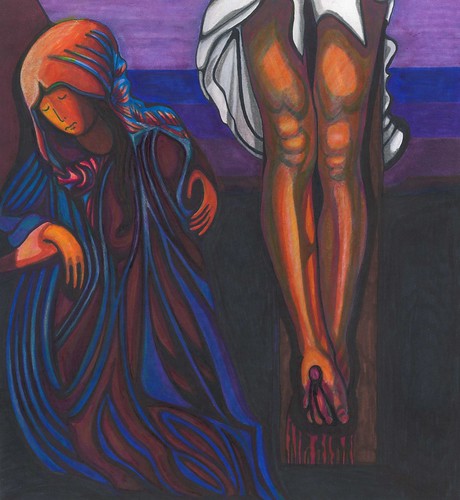
MAY DEVOTION: Day Twenty-Four - Mary at the Foot of the Cross


24th Day — Mary at the Foot of the Cross

There stood by the cross of Jesus His Mother. (St. John xix. 25.)

1. What words can ever describe the indescribable anguish that rent the sacred heart of Mary as she looked upon her divine Son hanging on the cross! Was there ever such a spectacle? He is so torn and mangled, covered with a mantle of blood from head to foot, that one can scarcely recognize in that unsightly figure the human form. Can it be He, the fairest among the children of men? My God, what can have transformed Him into this piteous, this ghastly object?

2. Every wound in Jesus' body was also a wound in the heart of Mary: every fiber, every nerve throbbing in agony. Every pang He suffered reechoed in her heart. She endured by her compassion a share in all the anguish of His Passion. What was the thick darkness around compared with the black darkness that overspread her heart!

3. Why did Mary suffer all this? That she might be our Mother, the Mother of mankind. She who brought forth her divine Son without a pang suffered many a piercing pang when from the cross her dying Son commended to her the sinful sons of men. That was indeed a maternity of sorrow she suffered for our sins: for mine.

Jesus, when the three hours were run,
Bequeathed thee from the cross to me.
How can I rightly love thy Son,
Sweet Mother, if I love not thee?

Pope Benedict XVI: CHRISTIAN PRAYER II

Dear Brothers and Sisters, 

Today I wish to continue my reflection on how prayer and the sense of religion have been part of man throughout his history.

We live in an age in which the signs of secularism are glaringly obvious. God seems to have disappeared from the horizon of some people or to have become a reality that meets with indifference. Yet at the same time we see many signs of a reawakening of the religious sense, a rediscovery of the importance of God to the human being’s life, a need for spirituality, for going beyond a purely horizontal and materialistic vision of human life. 

A look at recent history reveals the failure of the predictions of those who, in the age of the Enlightenment, foretold the disappearance of religions and who exalted absolute reason, detached from faith, a reason that was to dispel the shadows of religious dogmatism and was to dissolve the “world of the sacred”, restoring to the human being freedom, dignity and autonomy from God. The experience of the past century, with the tragedy of the two World Wars, disrupted the progress that autonomous reason, man without God, seemed to have been able to guarantee. 

The Catechism of the Catholic Church says: “In the act of creation, God calls every being from nothingness into existence.... Even after losing through his sin his likeness to God, man remains an image of his Creator, and retains the desire for the one who calls him into existence. All religions bear witness to man’s essential search for God” (n. 2566). We could say — as I explained in my last Catecheses — that there has been no great civilization, from the most distant epoch to our day, which has not been religious.

Man is religious by nature, he is homo religiosus just as he is homo sapiens and homo faber: “The desire for God” the Catechism says further, “is written in the human heart, because man is created by God and for God” (n. 27). The image of the Creator is impressed on his being and he feels the need to find light to give a response to the questions that concern the deep sense of reality; a response that he cannot find in himself, in progress, in empirical science.

The homo religiosus does not only appear in the sphere of antiquity, he passes through the whole of human history. In this regard, the rich terrain of human experience has seen the religious sense develop in various forms, in the attempt to respond to the desire for fullness and happiness. The “digital” man, like the cave man, seeks in the religious experience ways to overcome his finiteness and to guarantee his precarious adventure on earth. Moreover, life without a transcendent horizon would not have its full meaning and happiness, for which we all seek, is spontaneously projected towards the future in a tomorrow that has yet to come.

In the Declaration Nostra Aetate the Second Vatican Council stressed in summary form: “Men look to their different religions for an answer to the unsolved riddles of human existence. The problems that weigh heavily on the hearts of men are the same today as in the ages past. What is man? — [who am I?] — What is the meaning and purpose of life? What is upright behaviour, and what is sinful? Where does suffering originate, and what end does it serve? How can genuine happiness be found? What happens at death? What is judgement? What reward follows death? And finally, what is the ultimate mystery, beyond human explanation, which embraces our entire existence, from which we take our origin and towards which we tend?” (n. 1).

Man knows that, by himself, he cannot respond to his own fundamental need to understand. However much he is deluded and still deludes himself that he is self-sufficient, he experiences his own insufficiency. He needs to open himself to something more, to something or to someone that can give him what he lacks, he must come out of himself towards the One who is able to fill the breadth and depth of his desire.

Man bears within him a thirst for the infinite, a longing for eternity, a quest for beauty, a desire for love, a need for light and for truth which impel him towards the Absolute; man bears within him the desire for God. And man knows, in a certain way, that he can turn to God, he knows he can pray to him. 

St Thomas Aquinas, one of the greatest theologians of history, defines prayer as “an expression of man’s desire for God”. This attraction to God, which God himself has placed in man, is the soul of prayer, that then takes on a great many forms, in accordance with the history, the time, the moment, the grace and even the sin of every person praying. Man’s history has in fact known various forms of prayer, because he has developed different kinds of openness to the “Other” and to the Beyond, so that we may recognize prayer as an experience present in every religion and culture.

Indeed, dear brothers and sisters, as we saw last Wednesday, prayer is not linked to a specific context, but is written on the heart of every person and of every civilization. Of course, when we speak of prayer as an experience of the human being as such, of the homo orans, it is necessary to bear in mind that it is an inner attitude before being a series of practices and formulas, a manner of being in God’s presence before performing acts of worship or speaking words. 

Prayer is centred and rooted in the inmost depths of the person; it is therefore not easily decipherable and, for the same reason, can be subject to misunderstanding and mystification. In this sense too we can understand the expression: prayer is difficult. In fact, prayer is the place par excellence of free giving, of striving for the Invisible, the Unexpected and the Ineffable. Therefore, the experience of prayer is a challenge to everyone, a “grace” to invoke, a gift of the One to whom we turn.

In prayer, in every period of history, man considers himself and his situation before God, from God and in relation to God, and experiences being a creature in need of help, incapable of obtaining on his own the fulfilment of his life and his hope. The philosopher Ludwig Wittgenstein mentioned that “prayer means feeling that the world’s meaning is outside the world”. 

In the dynamic of this relationship with the one who gives meaning to existence, with God, prayer has one of its typical expressions in the gesture of kneeling. It is a gesture that has in itself a radical ambivalence. In fact, I can be forced to kneel — a condition of indigence and slavery — but I can also kneel spontaneously, declaring my limitations and therefore my being in need of Another. To him I declare I am weak, needy, “a sinner”. 

In the experience of prayer, the human creature expresses all his self-awareness, all that he succeeds in grasping of his own existence and, at the same time, he turns with his whole being to the One before whom he stands, directs his soul to that Mystery from which he expects the fulfilment of his deepest desires and help to overcome the neediness of his own life. In this turning to “Another”, in directing himself “beyond” lies the essence of prayer, as an experience of a reality that overcomes the tangible and the contingent.

Yet only in God who reveals himself does man’s seeking find complete fulfilment. The prayer that is openness and elevation of the heart to God, thus becomes a personal relationship with him. And even if man forgets his Creator, the living, true God does not cease to call man first to the mysterious encounter of prayer.

As the Catechism says: “in prayer, the faithful God’s initiative of love always comes first; our own first step is always a response. As God gradually reveals himself and reveals man to himself, prayer appears as a reciprocal call, a covenant drama. Through words and actions, this drama engages the heart. It unfolds throughout the whole history of salvation” (n. 2567).

Dear brothers and sisters, let us learn to pause longer before God, who revealed himself in Jesus Christ, let us learn to recognize in silence, in our own hearts, his voice that calls us and leads us back to the depths of our existence, to the source of life, to the source of salvation, to enable us to go beyond the limitations of our life and to open ourselves to God’s dimension, to the relationship with him, which is Infinite Love. Many thanks. 

GENERAL AUDIENCE
St. Peter's Square
Wednesday, 11 May 2011